The Deficiency List That Reset Itself

The punch list showed 84 open items on Monday morning. By Friday afternoon it showed 91. Nothing on site had gotten worse that week — crews had closed dozens of deficiencies. The list was simply getting confused, and occupancy was three weeks away.
This was a six-storey residential building, near completion, with the developer's site rep, the general contractor, and three trades all working from what everyone called 'the deficiency list.' The trouble was that no two people were looking at the same version of it, and no one could say with confidence which items were actually finished.
How a 'closed' item quietly reopens
A tiler marks a bathroom complete and moves on. The next day the developer's rep walks the unit, finds a lippage issue, and adds the item back to her copy of the list. The GC's copy still shows it closed. Now the same deficiency exists in two states at once — done and not done — depending on whose file you open. Multiply that by 84 items and five people, and the count stops meaning anything at all.
The root problem was never workmanship. It was that the word 'closed' had no single, recorded definition. Closure lived in someone's memory, a photo texted on Tuesday, or a verbal 'yeah, that's handled' in a stairwell. None of it was anchored to one authoritative record, so the list could reset itself every time two versions collided.
The hidden cost of a list nobody trusts
When the count can't be trusted, people compensate by re-checking everything. That is the expensive part. On a project this size, the drift showed up in four ways:
Duplicate inspections. The same unit walked three and four times because no one believed the previous sign-off.
Occupancy slips. The building was physically ready before the paperwork could prove it, delaying the occupancy permit and the first tenants.
Disputed holdback. Trades argued their work was done; the developer couldn't release funds against a list she couldn't verify.
Eroded trust. By the final weeks, every party assumed the list was wrong, so meetings became re-litigation instead of progress.
None of those costs came from bad building. They came from a record that couldn't hold a single version of the truth.
What the numbers actually did
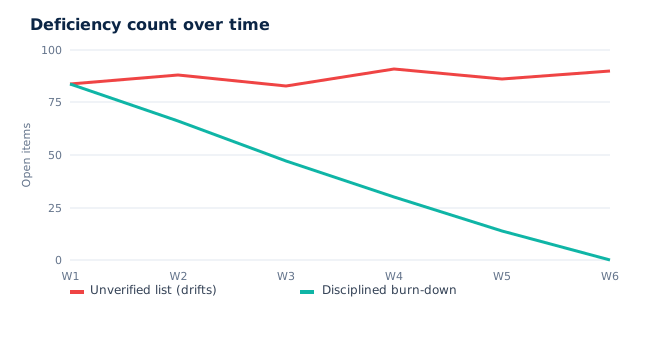
A trustworthy list only ever moves in one direction. The moment closure becomes a claim instead of a record, the line stops falling and starts to wander — and every wander is a re-inspection nobody budgeted for.
What 'closed' has to mean
A deficiency is not closed because a trade says so, and not closed because a rep remembers walking it. It is closed when a recorded event says so — and that event needs four things:
Who verified it, by name, not 'the trades.'
When, with a real date and time, not 'last week.'
Against what standard, the spec or tolerance the item had to meet.
With proof, a photo or sign-off attached to that item, in one place everyone reads from.
When closure is a recorded event rather than a claim, a closed item stays closed. The count only falls, and the sawtooth flattens into a clean burn-down toward occupancy.
What to do before your next handover
Pick one list, in one location, with one definition of 'closed' that everyone agrees to before the walk-throughs start. Ban the private copies. The goal isn't a prettier spreadsheet — it's a number that means the same thing to the developer, the GC, and the trades on the same afternoon. That single shared record is exactly the discipline we built XNM-VISION to make automatic, so closure is captured once and never argued twice.
A punch list that resets itself is really a version-control failure wearing a hard hat. For more field-tested ways to keep one record everyone trusts, browse the XNM blog.