One Chart: The Hidden Headcount in Manual Records

Nobody on your team has 'filing' in their job title. And yet, if you added up the hours your staff spend hunting for documents, re-creating ones they can't find, and manually moving information from one system to another, you might discover you employ two or three full-time filers you never hired.
That's the hidden headcount in manual records: real salaried hours, spread so thin across so many people that no one sees the total. This piece is about making that total visible — because you can't manage a cost you've never counted.
Where the hours actually hide
The time doesn't disappear in one dramatic place. It leaks in small, forgettable increments that each feel too minor to measure:
Searching. The minutes spent looking for a document that exists but isn't where you expected — several times a day, per person.
Re-creating. Rebuilding a file someone couldn't find, so the same work gets done twice.
Re-keying. Typing the same information into a second and third system by hand because nothing talks to anything.
Reconciling. Working out which of three versions is the real one before you can act.
Each of these feels like the job. None of them is the job. They're the tax you pay on a manual records system, collected in coins so small you never notice the pile.
Doing the math
Run a rough calculation for your own team. Suppose each person loses just thirty minutes a day to searching, re-creating, and re-keying — a conservative figure in most offices. Across teams of different sizes, over a working year, that's the chart below:
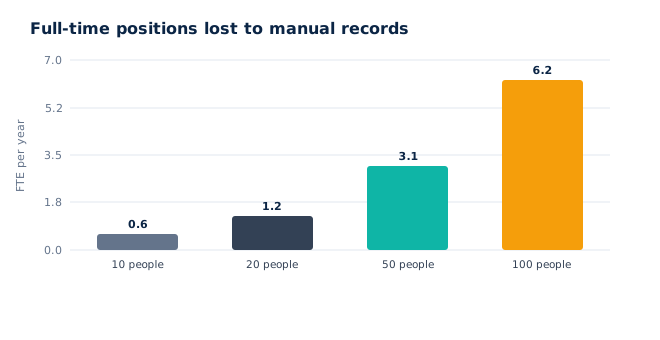
These are illustrative figures, not a claim about your specific office — run them with your own headcount and your own honest estimate of lost minutes. Even a conservative pass usually turns up at least one full-time position's worth of hours, paid for and invisible.
Why the number stays hidden
The hidden headcount survives because it never appears on a single line. No one budgets for 'searching.' No manager watches an employee lose four minutes here and seven minutes there. The cost is real but structurally invisible — which is exactly why it never gets fixed. A cost no one can see is a cost no one is accountable for.
What the chart is really telling you
The point isn't to shame anyone for slow filing. It's that the hours are already being spent — you're already paying for those two or three phantom filers. The only question is whether they're producing anything. Redirect even half of that time by making records findable, and you've effectively added staff without adding payroll.
The one number worth finding
Before you buy a system, hire a coordinator, or launch a cleanup, find this number for your own team. It reframes the whole conversation: you're not spending money to solve a records problem, you're recovering money you're already losing. That's a far easier case to make — and a far harder one to ignore.
The most expensive number in your operation is often the one nobody's counting. For more single-chart arguments about where project time really goes, see more on the XNM blog.