Field Notes: Health Authorities and Multi-Site Records

A regional health authority might run forty buildings — hospitals, clinics, long-term care homes, labs — spread across hundreds of kilometres. Each was built at a different time, by a different contractor, under a different standard. Somewhere in that sprawl is the drawing that shows which wall you can safely cut into. The question is whether anyone can find it before the saw comes out.
This is the defining records challenge of a health authority: not one building's paperwork, but dozens of buildings' paperwork, held to dozens of different local habits, that all have to behave like one system the moment it matters.
Same authority, many worlds
Walk three sites in the same authority and you'll often find three filing cultures. The old hospital keeps as-builts in a basement drawing room. The new ambulatory clinic has everything in a cloud folder. The care home two towns over relies on a facilities manager who 'knows where things are' — until he retires. All three are technically compliant. None of them can hand the next site their file in a form that's usable on arrival.
Why fragmentation is dangerous here, specifically
In most sectors, a lost drawing is an inconvenience. In health care, the stakes are physical and immediate:
Infection control. A renovation in an occupied hospital depends on knowing exactly where air-handling zones and containment barriers run. That's a records question before it's a construction one.
Life-safety systems. Fire separations, medical-gas lines, and emergency-power routes all live in drawings. Cutting blind is not an option in a building full of patients.
Continuous operation. You can't close a hospital to sort its files. The record has to be right while the building runs around the clock.
Accreditation. Surveyors ask to see maintenance and compliance records across sites — and a strong site can be undone by a weak one.
A health authority is only as documented as its least-documented building. One basement drawing room can put the whole network's accreditation at risk.
What 'one standard' actually looks like
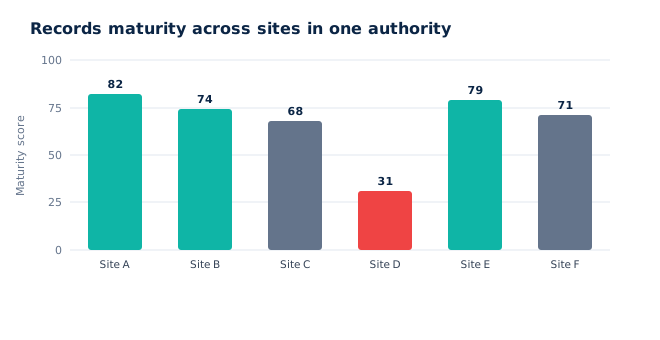
The fix is rarely a single heroic migration. It's a common standard that every site is brought up to, one category at a time, starting with the records that carry life-safety consequences.
How the strongest authorities close the gap
One naming and filing standard every site follows, regardless of local history.
Life-safety and infection-control drawings prioritized first — the records where a gap can hurt someone.
A single index of where each site's records live, so a project team arriving at any building starts from a known place.
Handover treated as a standard, not a favour — when a facilities manager leaves, the knowledge stays.
None of this requires ripping out what already works. It requires agreeing on what 'good' looks like and pulling every site toward it, hardest cases first.
The takeaway
Multi-site records management isn't a bigger version of single-site filing — it's a different problem. The goal isn't perfection at every building tomorrow. It's one standard, applied unevenly at first but relentlessly, so that the authority behaves like one organization the day a wall has to come down safely.
The multi-site problem shows up anywhere one organization runs many locations. For field notes from other sectors facing the same test, read more on the XNM blog.