A Retention Schedule for Public-Sector Records, Explained

Two questions sink most public-sector records programs. The first: are we keeping something we were legally required to destroy? The second: did we destroy something we were legally required to keep? A retention schedule is the single document that answers both — and a surprising number of teams are running without one.
A retention schedule is not bureaucracy for its own sake. It is a plain list that says, for each type of record your organization creates, how long to keep it and what to do when that time is up. Done well, it turns 'keep everything forever, just in case' into a defensible, repeatable routine.
Why 'keep everything' is the risky option
It feels safe to keep every email, draft, and file indefinitely. It isn't. Records you no longer need are still discoverable in litigation, still subject to freedom-of-information requests, and still cost money to store and search. Keeping everything doesn't reduce risk — it just spreads it across a larger and larger pile.
The anatomy of a retention schedule
Every workable schedule has the same handful of columns. You do not need special software to start — a single table will do:
Record type. The category, in language your team actually uses: council minutes, procurement files, employee records, capital-project drawings.
Retention period. How long you keep it, tied to a trigger: '7 years after contract closeout,' not just '7 years.'
Legal basis. The statute, regulation, or policy that sets the period, so the rule is defensible later.
Disposition. What happens at the end: secure destruction, transfer to archives, or permanent retention.
Trigger event. The date the clock starts — fiscal year-end, project completion, employee departure.
Where public-sector teams get it wrong
The classic mistake is writing a beautiful schedule and never applying it. A schedule that lives in a binder while the shared drive grows unchecked protects no one. There are two failure modes, and they are mirror images of each other:
Over-retention — hoarding records past their period, multiplying freedom-of-information and litigation exposure.
Under-retention — destroying records early, then being unable to prove a decision, a payment, or a compliance step when it is asked for.
Both are avoidable, and both come from the same gap: a schedule that isn't wired into how records are actually stored and disposed of.
A starter you can build this quarter
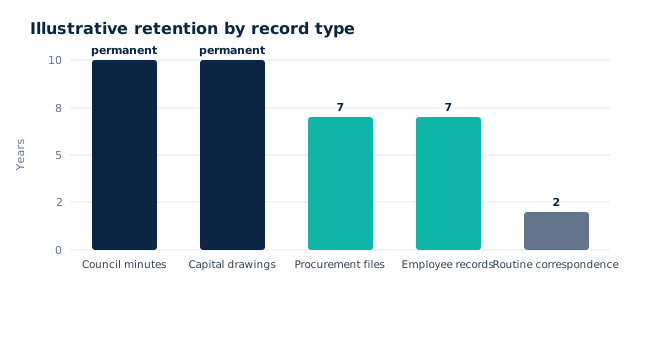
Treat those figures as a starting shape, not legal advice: the exact periods depend on your jurisdiction and the statutes that govern you. The point is the pattern — every record type gets a period, a basis, and a disposition, and a couple of categories will be permanent.
Making the schedule actually run
Inventory first. You can't schedule records you haven't listed. Start with the categories that carry the most risk.
Tie periods to triggers, not calendar guesses, so the clock starts on a real, recorded event.
Automate the reminder, so disposition happens on time instead of never.
Log every disposition, so 'we destroyed it, on schedule, per policy' is itself a record you can produce.
That last point matters most. Defensible disposal isn't just destroying records on time — it's being able to prove you did, under the rule that authorized it. The log of what you disposed of is as important as the disposal itself.
The payoff
A live retention schedule turns records from a growing liability into a managed asset. When a freedom-of-information request or an audit lands, you're not guessing what you have and why — you're pointing to a rule. Start with one table, the riskiest categories first, and a reminder that actually fires.
Retention is the quiet backbone of every trustworthy public record. For more practical guides on keeping what matters and disposing of the rest, explore more on the XNM blog.