The Backlog Behind the Campus: Why Capital Renewal Is a Records Problem

Every school district and university carries an invisible liability that rarely makes the brochure: the gap between the buildings it has and the money it has to keep them standing. Deferred maintenance - the roof not replaced, the boiler limping along, the envelope quietly failing - accumulates building by building until it becomes a number large enough to dominate a capital plan. And the institutions that manage it best are not necessarily the ones with the biggest budgets. They are the ones who can actually see the backlog: what is failing, where, how urgently, and what it will cost to fix.
That visibility is a records problem before it is a funding one. A facilities portfolio is a deep archive - building condition assessments, warranties, equipment histories, prior repairs, drawings, and the funding applications and reporting that justify every dollar spent. When that record is scattered across a maintenance system, a few binders, and the institutional memory of long-serving staff, a district cannot do the one thing the backlog demands: prioritize credibly. You cannot defend a funding request for the roof you cannot document, sequence repairs you cannot see, or prove to a ministry that the money it gave you went where it was needed. The backlog you cannot measure is the backlog you cannot manage.
Recent context
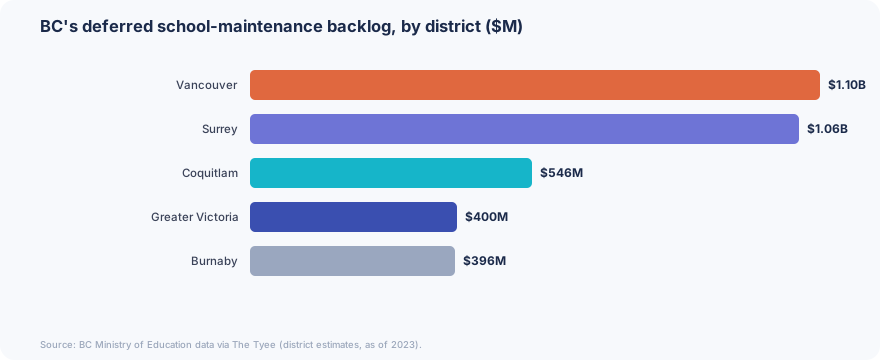
The numbers are stark and growing. British Columbia's deferred school-maintenance backlog has climbed toward $9 billion, with Vancouver and Surrey each carrying over $1 billion in district estimates. The pressure is the same in higher education: a 2026 sector report found the capital-renewal backlog at North American colleges and universities rose 8% to about $156 per gross square foot, with capital reinvestment running well below the level needed just to hold the line. Across both, the need is outpacing the funding - which makes how well you document and defend each project decisive.
Funding follows the institutions that can document the need
Capital comes with strings, and the strings are records. A 2026 review of higher-education facilities found capital reinvestment at roughly 73.5% of the level required just to keep facilities from degrading further - meaning institutions are competing for scarce dollars they cannot afford to waste or fail to account for. A funder, a ministry, or a board approving a campus build wants to see the condition data behind the ask, the contracts and change orders behind the spend, and the reporting that proves the money landed where it was promised. The institution with a clean, current facilities record makes that case in an afternoon. The one reconstructing it from binders makes it slowly, partially, and from a weaker position.
How XNM helps
XNM helps school districts and post-secondary institutions bring the facilities and capital record into one auditable command centre - condition assessments, warranties, equipment histories, repairs, drawings, and the funding applications and reporting tied to each project. Where it helps, the XNM-Vision platform gives facilities and capital-planning leaders a portfolio view of the whole building stock, so the backlog can be prioritized on evidence rather than memory, and a funding case or ministry report is assembled from a current record rather than rebuilt under deadline. And because it stands up in days rather than the months a records project usually takes, the control arrives in time to shape the next capital cycle.
Practical takeaways
Measure the backlog before you manage it. You can only prioritize, fund and defend the deferred maintenance you can actually document, building by building.
Tie every funding ask to its condition data. A request backed by a current assessment and a clear cost basis is far harder for a funder to set aside.
Keep the spend traceable to the report. When a ministry asks whether the money went where it was promised, the answer should already be assembled.
Build a portfolio view of the building stock. Sequencing repairs across dozens of buildings needs one line of sight, not a stack of disconnected systems.
Preserve the history, not just the asset. Warranties, prior repairs and equipment records are what keep a renewal decision from starting at zero each time.
FAQ
We have a maintenance management system. Isn't the record already covered?
A maintenance system tracks work orders; it does not always tie condition data, drawings, contracts and funding reporting into one defensible record per building. The gap most institutions hit is at the capital and funding layer - the evidence a ministry or board actually wants - not the day-to-day work-order layer.
Our deferred-maintenance list is already huge. Won't better records just make it look worse?
It makes it look accurate - which is exactly what unlocks funding. A vague, undocumented backlog is easy for a funder to discount; a precise, evidence-backed one, prioritized by urgency and cost, is a credible case for investment. Documentation does not inflate the problem; it makes it fundable.
The bottom line
A deferred-maintenance backlog is a records problem dressed as a budget one. The districts and institutions that manage it best are the ones that can see it - every building's condition, cost and history in one place, ready to prioritize and defend. As the need outpaces the funding, the campuses that document their backlog clearly are the ones that will actually get it funded. You cannot fix what you cannot see, and you cannot fund what you cannot prove.