The As-Built That Wasn't
The renovation crew came to move one wall. The as-built drawing, stamped "final," showed the cavity behind it as empty framing. Two hours in, a saw blade found a live 200-amp feeder the drawing swore wasn't there. Work stopped for a week.
The drawing wasn't malicious. It was just wrong, and worse, it was confidently wrong. Somebody had labelled it "as-built," the word that tells everyone downstream: this is what we actually constructed, you can trust it. A field change during the original build, rerouting that feeder around an obstruction, had never made it back onto the record. For years the drawing looked authoritative and was quietly a lie. Why a document everyone trusted could be so wrong is the whole story, and it starts with what "as-built" is supposed to mean.
"As-built" is a promise, not a label
A set of design drawings says what a building was supposed to be. An as-built says what it actually became, capturing every field change, substitution, and reroute that happened between the first shovel and the final walk-through. That distinction is the entire value. Design intent is a hypothesis; the as-built is the tested result. When you open a wall, dig a trench, or tie into an existing system twenty years later, the as-built is the only thing standing between a clean job and a very bad surprise.
The problem is that as-builts are usually assembled at the end, from memory and a pile of marked-up prints, by people racing to close the project and move on. A change made in month three gets reconstructed in month eighteen by someone who wasn't there. The result carries the authority of a final document without the accuracy of one. It looks done. It reads as truth. And nobody discovers the gap until a saw blade does.
The three moments an inaccurate as-built costs you
The next renovation. Every future project trusts the as-built as its starting point. If it's wrong, the new design is wrong, the estimate is wrong, and the crew finds out mid-demolition, at the most expensive possible moment to learn.
The emergency. A pipe bursts, a panel faults, a leak spreads. Someone needs to know what's behind that wall right now. An inaccurate as-built turns a two-hour fix into a two-day exploratory teardown while the damage keeps running.
The handover or sale. When ownership changes, the as-builts are the asset's memory. A buyer's due-diligence team, or a new facilities manager, inherits whatever the record says. Gaps discovered later become disputes, warranty fights, and eroded trust.
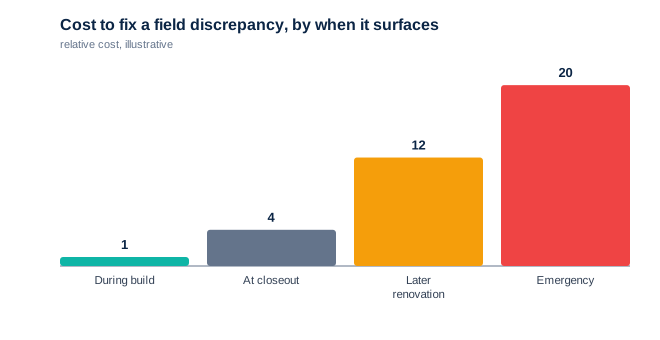
What ties these together is timing. The same field discrepancy costs almost nothing to record the day it happens and a fortune to discover years later. The curve isn't gentle.
How to make an as-built that's actually built
The fix isn't a better drafting program. It's a habit: capture the change when it happens, not when the project ends. Every field revision, substitution, and reroute gets redlined and dated in the moment, by the person who made it, against the current controlled drawing set, so the as-built assembles itself as you go instead of being reconstructed under deadline.
Redline in the field, the same day, against the controlled current set, not a stray print.
Tie every redline to who made the change and why, so the reasoning survives the person.
Reconcile redlines into the master set at each milestone, not once at the very end.
Verify the final as-built against reality before anyone stamps it "final" — a spot-check now is cheaper than a saw blade later.
The as-built is the building's memory
A building outlives the people who built it. The as-built is how it remembers what it's made of, and an inaccurate one doesn't just lose information, it actively misleads the next person who trusts it. "Final" should mean verified, not merely finished. The most expensive drawing in any archive is the one everyone believes and no one has checked.
If a confidently wrong document can cost a week, it's worth asking what other "final" records in your projects have never actually been verified. More field stories and records playbooks run every week on the XNM blog.