Field Notes: Municipal Asset Management Starts With Records

A mid-sized municipality owns more than most people imagine: kilometres of water main, hundreds of hydrants, bridges, pumps, fleet vehicles, playgrounds, buildings, streetlights. On paper it's a billion-dollar portfolio. In practice, ask where the condition record for a specific 1978 culvert lives, and you'll often get a pause, a name, and a hope that the person who knows still works there.
Asset management is the discipline that's supposed to answer that question — what do we own, what condition is it in, when does it need money. Every province is pushing municipalities toward it, and most have a plan, a policy, and a spreadsheet. What they often don't have is the thing underneath it all: a records base solid enough to manage from. Because you can only manage what you can actually document.
Asset management is a records problem wearing a finance hat
The visible face of asset management is financial — replacement values, depreciation, a long-range capital plan. But every number in that plan rests on a record: an install date, a material, an inspection, a repair history, a warranty. When those records are complete, the plan is a forecast. When they're guesses, the plan is fiction with a spreadsheet's confidence. A culvert with no condition record isn't "in good shape," it's unknown, and unknown is where emergencies come from.
What actually lives behind a municipal asset register
Install and commissioning records — how old is it, really, and who built it.
Inspection and condition history — the trend line that predicts failure before it happens.
Maintenance and repair logs — what's been done, and what keeps coming back.
Warranty and contract documents — is someone else still on the hook for this.
Spatial and network data — where it is, and what fails with it when it goes.
When those five live in one place per asset, the register is alive. When they're scattered across a works-order system, a GIS layer, a filing cabinet, and an engineer's memory, the register is a list of names with no story behind them, and a list can't tell you what to fix first.
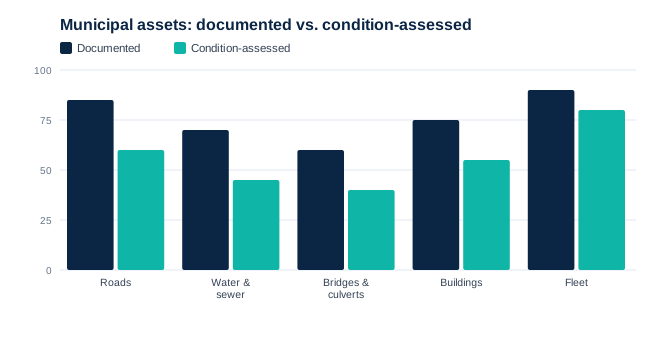
The gap shows up the moment you compare what a municipality owns to what it can actually document. Coverage is almost never uniform, and the low-coverage categories are exactly where risk hides.
Where to start when the portfolio is huge
You don't fix a billion-dollar portfolio's records in a quarter. You triage. Rank assets by consequence-of-failure — a water main under a hospital access road outranks a park bench — and drive documentation completeness up on the critical few first. For each critical asset, get the five records above into one place, then widen the circle. Asset-management maturity isn't a big-bang project; it's a coverage line you push up, one high-consequence asset at a time.
The register is only as real as the records under it
A municipal asset register is a promise to the public: we know what we own and we're stewarding it. That promise is only as true as the records beneath it. Every complete record turns a guess into a plan; every gap is a future emergency waiting for a budget cycle it wasn't in. Managing municipal assets doesn't start with a dashboard. It starts with being able to document, honestly, what condition each thing is in.
This is the records backbone behind every capital and maintenance decision a municipality makes. See how records support municipal capital work, and read the rest of the Field Notes sector series on the blog.