The Public's Right to Know Starts With Your Files

Open government is usually pitched as a matter of will — portals, disclosure logs, freedom-of-information laws, a promise to be transparent. But strip away the policy language and transparency runs into a very physical wall: you can only disclose what you can find. The public's right to know is only as real as the file it lives in.
That's an uncomfortable reframe, because it moves transparency out of the realm of principle and into the realm of records management. A government can mean every word of its openness pledge and still fail it — not through cover-up, but through disorganization. When a citizen asks a question and the answer is technically on file but practically unfindable, the right to know has been denied just as surely as if someone shredded it. The failure just looks like a delay instead of a scandal.
Transparency is a retrieval problem before it's a values problem
We tend to imagine the enemy of transparency as secrecy — someone actively hiding something. In practice, the far more common enemy is friction. The record exists, but it's in an inbox nobody can search, or a shared drive nobody has mapped, or a format nobody can open, or the head of someone who retired. The information isn't withheld; it's just effectively unreachable. To the person who asked, the difference is invisible. A denied answer and an unfindable one feel exactly the same.
What a records request really tests
A public records request is an unannounced audit of your files. It doesn't test your intentions; it tests your retrieval. And it exposes, in a way nothing else does, the gap between "we have good records" and "we can produce them on demand." The three-week scramble to answer a simple question isn't a sign of a hostile requester — it's a sign that the truth was scattered, and that on any ordinary day the organization itself couldn't quickly see what it knew.
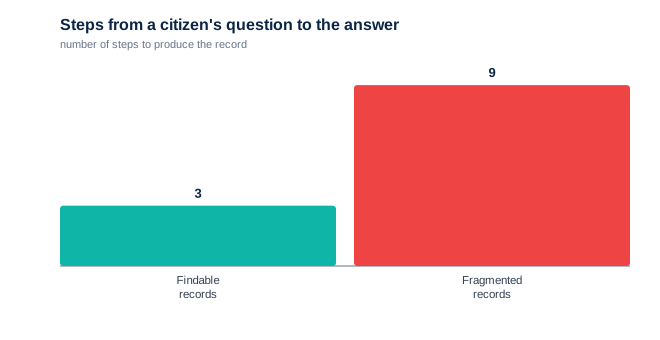
The distance between a question and its answer is measured in the steps and systems you have to cross to get there, and that distance is a choice you make long before anyone asks.
Findable is the real measure of open
If we're honest, the test of an open institution isn't the mission statement on its transparency page. It's whether an ordinary question can be answered quickly, completely, and confidently from the record — without a scramble, without a hero, without hoping the right person still works there. Transparency as a value is cheap. Transparency as a capability is built, file by file, long before anyone exercises their right to know.
Which means the most democratic thing many organizations could do this year is unglamorous: make their own files findable. Not for the audit, not for the request, but because a public that can't get answers doesn't experience good intentions — it experiences a closed door. And the door isn't locked. It's just buried.
Openness starts as a records discipline, not a press release. Read the rest of The Records Test series for more on why the file is where trust is actually kept.