One Chart: How Many Systems Hold One Project's Truth

Pick one active capital project and ask a simple question: where does the truth about it live? Not where it should live — where it actually is, right now, if you had to reconstruct the full picture this afternoon. Count the places. For most projects the honest answer is a number that would alarm the people running it.
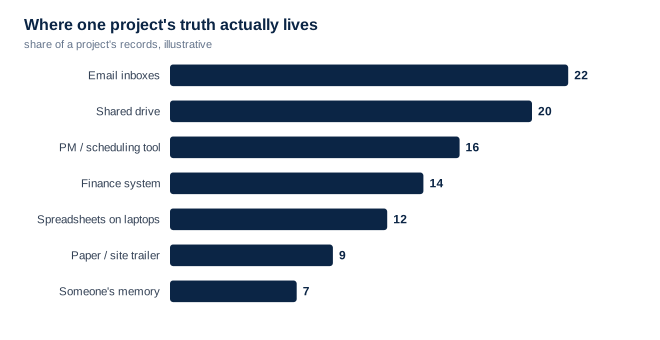
That number is the whole point of this piece. A single project's truth — its budget, schedule, changes, approvals, correspondence, drawings, and decisions — is almost never in one place. It's smeared across a handful of systems that don't talk to each other, plus a few that aren't systems at all. The chart below is what that looks like, and once you've seen it, you can't unsee it in your own projects.
The truth is scattered, and each fragment thinks it's complete
Here's the trap: every one of those systems feels authoritative from the inside. Finance is sure it has the budget. The scheduler is sure they have the timeline. The site super is sure the daily logs tell the story. Each is right about its fragment and blind to the others. There is no view that holds all of it, so "the truth about the project" isn't anywhere — it's an assembly job that only exists in a person's head, and only until that person leaves.
Counted honestly, here's where one ordinary project's truth actually lives.
Why fragmentation is expensive, not just annoying
Reconciliation tax. Every report, audit, or status meeting starts by re-merging the fragments. That merge is manual, repeated, and never quite complete.
Version ambiguity. When the same fact lives in six places, six versions drift apart, and no one can say which is current without asking around.
Single-person risk. The only place the fragments come together is in the head of whoever last assembled them. When they leave, the assembled picture leaves too.
None of this is a discipline problem or a smart-people problem. It's a structural one: the pieces were never designed to sit in one place, so they don't, and the cost is paid over and over in reconciliation, confusion, and fragility. And it scales the wrong way — the bigger and longer the project, the more systems accumulate and the more expensive every reconciliation becomes, so the projects that most need a clear picture are exactly the ones least likely to have one.
The one question worth asking this week
You don't need to boil the ocean to act on this. Take your most important active project and just count, honestly, how many distinct places hold a piece of its truth. Write the number down. That number is your fragmentation score, and it's also your reconstruction risk — the number of places someone would have to visit to rebuild the project if the person holding it in their head walked out tomorrow. The goal isn't zero. It's small enough that the picture lives in the system, not in a person.
If that count surprised you, you're not alone — it's the most common quiet risk in project work. More One Chart pieces visualize the costs that hide in plain sight.