The Announced Price Isn't the Project Cost: Why a Hospital Build's True Cost Lives in Its Records
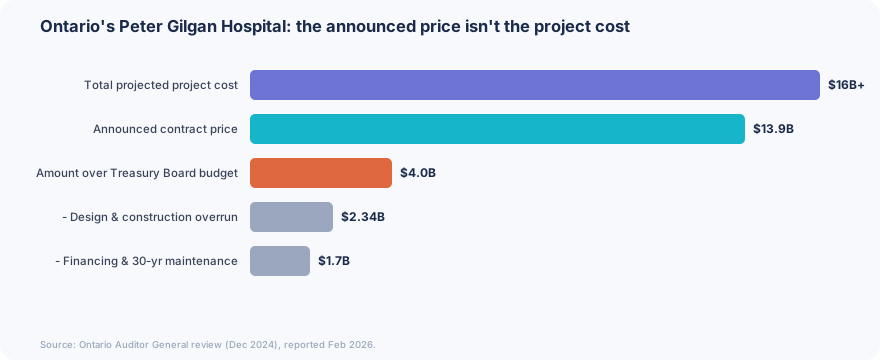
When Ontario announced a $13.9-billion contract to rebuild the Mississauga Hospital as the new Peter Gilgan Hospital, the figure was already not the whole story. The province's Auditor General had found the project running roughly $4 billion over its Treasury Board budget, and the announced contract price - large as it is - leaves out internal legal, consulting and contingency costs that push the total past $16 billion. None of that means anyone acted in bad faith. It means a hospital build is so large, so long, and so layered that its true cost is almost impossible to see unless someone keeps one honest, complete record of every dollar.
Hospital and health-authority capital projects are among the most complex any public body ever undertakes. A single tower runs for the better part of a decade, carries a contract value in the billions, and generates a blizzard of records along the way: the business case, the Treasury Board or board-of-directors approvals, the procurement file, the construction contract, the financing terms, change orders, the equipment and medical-device fit-out, commissioning sign-offs, and the thirty-year maintenance agreement that often dwarfs the build itself. When those records live in different systems owned by different parties - the ministry, the health authority, the developer, the financier - no one holds the single view that answers the only question a board really has: what will this actually cost, and why?
Recent context
The gap between the headline and the truth is now a matter of public record. Reporting in February 2026 on Ontario's Auditor General review put the new Peter Gilgan Hospital about $4 billion over its Treasury Board budget - $2.34 billion in design and construction alone, and roughly $1.7 billion more in added financing and 30-year maintenance costs. The Auditor General also noted that the announced contract price 'is not the total project cost,' because it excludes internal costs such as legal, consulting and contingencies. The number the public heard and the number the project will cost were never the same.
The real cost is a records question before it is a budget question
It is tempting to file this under 'big projects go over budget,' but that misses the mechanism. A cost overrun of this size is rarely one bad decision; it is dozens of smaller ones - scope additions, financing assumptions, escalation, contingency draws - each defensible on its own and recorded somewhere, but never assembled into a single current picture until an auditor does it years later. By then the board is reacting to history. The same money discipline a health authority applies to its operating budget has to apply to the capital file: every approval, every change order, and every cost line tied to the project, current, and visible to the people accountable for it. The thirty-year maintenance tail makes this sharper still - more than half of a project's lifetime cost can sit in an agreement signed at the start and forgotten until it bites. A record that captures the whole obligation, not just the construction price, is the only way a board sees what it is really committing to.
How XNM helps
XNM helps health authorities and hospital boards pull the entire capital-project record into one auditable command centre - the business case, approvals, procurement file, contract, financing terms, change orders, equipment fit-out, commissioning, and the long maintenance agreement, tied together and kept current. Where it helps, the XNM-Vision platform gives a board and its capital-planning team a single line of sight over the true, all-in cost and the decisions that moved it - so the number in the boardroom is the number on the project, not a headline that excludes half the obligation. When the ministry, an auditor, or the public asks why the cost changed, the answer already exists in a defensible, time-stamped form. And because it stands up in days rather than the many months a records overhaul usually takes, the visibility arrives while the project can still be steered, not after the ribbon is cut.
Practical takeaways
Track the all-in cost, not the announced price. The contract value is a fraction of the lifetime obligation; a board needs financing, maintenance and internal costs in the same record or it is governing on a partial number.
Tie every change order to the project file. Overruns accumulate one approved change at a time - capture each against the project so the running total is always current, not reconstructed later.
Treat the 30-year maintenance tail as a first-class cost. More than half of lifetime cost can sit in the maintenance agreement; keep it visible from day one, not buried until it bills.
Make the capital file audit-ready by default. Auditors and the ministry will ask what was approved and why; keep the record in a state where the answer is already there.
Give the board one current cost view. A board accountable for billions needs a single, live picture of cost and commitments - not a quarterly slide that lags the project by months.
FAQ
Isn't a hospital overrun just the nature of mega-projects?
Scale and time make overruns more likely, but they don't make them invisible by necessity. What turns a manageable variance into a multi-billion-dollar surprise is a record no one can see whole until it is too late to act. The size you can't control; the visibility you can. A current, complete capital record is how a board catches drift early instead of explaining it afterward.
We have a project management office already. Isn't that the record?
A PMO runs the schedule and the work; it doesn't automatically give the board a governed, all-in cost record spanning financing and the maintenance term, often held by other parties. The value is a single source of truth the board itself can rely on - where the cost number, the approvals behind it, and the long-term obligations all live together and stay current.
The bottom line
A hospital is one of the largest financial commitments a community ever makes, and the announced price is almost never the real one. The boards that govern these projects well are not the ones that avoid all surprises - they are the ones whose record lets them see the true cost early, while there is still room to act. The dollar figure is the headline; the record is how a board learns what it actually signed up for.