One Chart: The ROI of Findability

There is a cost on your project that has no budget line, no purchase order and no owner, and on most teams it is larger than the software budget it would take to reduce it. It is the time your people spend looking for things they already have.
It never shows up because it is not spent in blocks. It is spent in four minutes here and eleven minutes there, in the scroll through a mail folder for the version with the markup, the message asking a colleague if they still have the signed one, the twenty minutes reconstructing a decision that was definitely made and definitely recorded somewhere. Every instance is too small to complain about. That is exactly why it survives.
The arithmetic, which you can redo in a minute
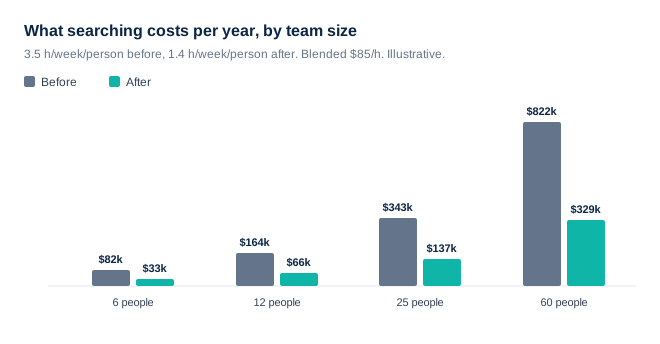
Take three and a half hours per person per week as the starting assumption. It is a figure worth testing rather than trusting, and the way to test it is to ask three people to keep a tally for one week. Most teams are surprised, usually upward, and the ones with the most experienced staff are often the worst, because senior people are the ones everyone interrupts to ask where things are.
Multiply that by a working year and a blended internal rate, and the per-person cost lands near fourteen thousand dollars a year. Nothing about that number is exotic. It is just hours times money, which is how every other cost on your project is calculated.
Why halving it is realistic and eliminating it is not
Nobody gets search time to zero, and any tool that promises it should be treated with suspicion. Some searching is thinking; a person browsing a folder is often orienting themselves rather than failing. The realistic target is the difference between searching and hunting, and hunting is what happens when there is no authoritative location, no consistent naming, and no record of who decided what.
Three changes account for most of the gap, and none of them are exciting. One place per class of record, so the question is which folder rather than which system. Names that a stranger can read, dated and describing the thing rather than its author's mood on the day. And decisions written where the document lives, so nobody has to reconstruct reasoning from a mail thread.
What the number is actually for
The point of this chart is not to justify a purchase. It is to move an invisible cost onto the page, because costs on the page get managed and costs in the walls do not. Once a team of twelve can see three figures a year attached to looking for things, the conversation changes from whether tidying up is worth the effort to which part of it to do first.
Run your own version this week. Three people, one week, a tally sheet. Multiply. Whatever number comes out, it has been true every year you have been in business, and it will keep being true until someone decides it is a line item.
Findability is the quiet return behind almost everything we build into XNM-VISION, but the arithmetic above belongs to you whether or not you ever use our software. If you want to see how the same idea plays out in insurance files, board packs and closeout binders, the rest of the series covers the ground.