Institutional Memory Is a System, Not a Person

Every organization has a person who just knows. Where the easement is. Why the budget changed in 2022. Which contractor to never call again. They're invaluable - right up until the morning they retire, resign, or take a better offer, and walk out the door with twenty years of your institutional memory in their head.
Here is the claim this article defends: if your institutional memory has a pulse, you don't have institutional memory. You have a person - and people leave. Real organizational memory is a system, and the difference shows up on the worst possible day.
Memory with a pulse is a liability
The person who knows feels like an asset. They're fast, they're trusted, they save everyone time. But every question only they can answer is a risk you've quietly accepted. The knowledge isn't owned by the organization; it's rented from an individual, and the lease can end without notice. When it does, the cost isn't just lost knowledge - it's every future decision made without it, every mistake repeated because no one remembered it was already tried.
What you actually lose when they leave
It's rarely the big, documented facts - those usually survive. It's the context: why a decision was made, what was tried and abandoned, who the real stakeholders are, where the bodies are buried in a thirty-year-old agreement. That tacit layer is the difference between repeating history and learning from it. And it's the layer that no exit interview ever fully captures.
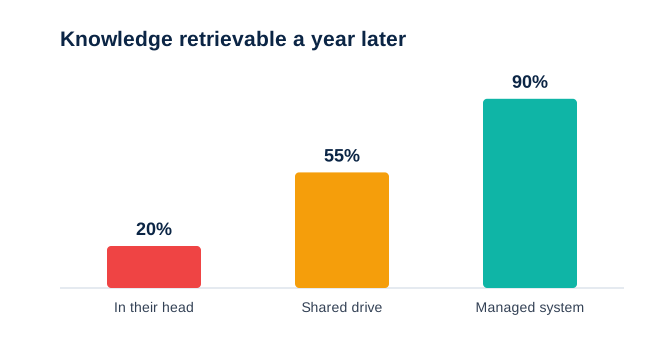
The illustrative pattern is stark: knowledge that lives only in someone's head is mostly gone within a year of their departure, while knowledge captured in a managed system stays largely intact. A shared drive helps - but only if anyone can actually find and trust what's in it. The point isn't write everything down. It's make the organization, not the individual, the place memory lives.
Turning memory into a system
You don't institutionalize memory with a heroic documentation sprint before someone retires. You do it by capturing decisions as they're made, in the flow of work, where the next person will look.
Record the why, not just the what. a decision without its reasoning is trivia; with its reasoning, it's guidance.
Capture in the flow, not after the fact. memory written at the moment is accurate; memory reconstructed at exit is sanitized.
Make it findable by a stranger. the test is whether someone who started last week could find and understand it.
Putting decisions, documents, and the reasoning behind them in one searchable place is exactly the problem we built XNM-VISION around - so the organization remembers even when people move on. But the principle stands on its own: capture the why, in the flow, where a stranger can find it.
Tomorrow, find your person who just knows and ask them one question only they can answer. Then write the answer down somewhere the whole organization can reach. Do that once a week, and in a year you'll have something your competitors don't: a memory that doesn't quit.
An organization that remembers is really an organization that can be trusted - we made that case here.