The $4-Billion Signal: Why Indigenous Capital Ownership Runs on the Record
In under a decade, the First Nations Finance Authority has moved from its first debenture to more than $4 billion in loans for community and economic infrastructure - water systems, roads, housing, and equity stakes in the energy and resource projects reshaping the Canadian economy. The number is a milestone. The signal underneath it is bigger: First Nations governments and their development corporations are moving from grant recipients to capital owners, and capital comes with a standard of proof that grants never demanded.
An economic-development corporation running a portfolio of businesses and capital projects on behalf of a First Nation carries a documentation load that would test any mid-sized enterprise - and usually carries it with a fraction of the staff. Financing agreements, own-source revenue records, equity and partnership structures, project budgets and change orders, employment and procurement commitments, board resolutions and the community mandates behind them. When a lender, an auditor, or a partner asks to see the file, the answer cannot be that it is somewhere across three inboxes and a shared drive. The record is what turns a good project into a financeable one.
Recent context
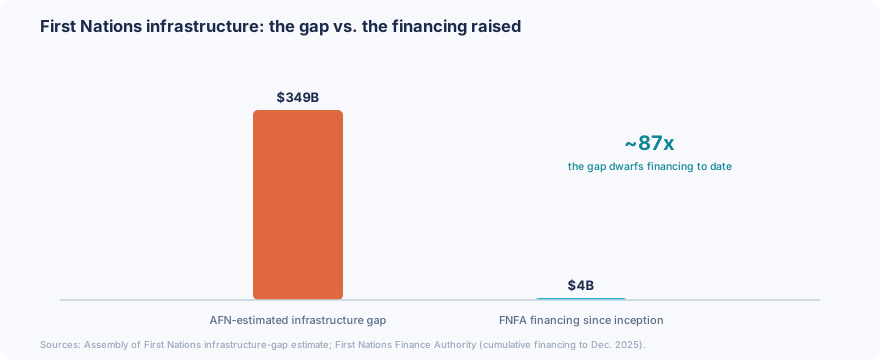
The direction of travel is clear. The First Nations Finance Authority reported in December 2025 that it has surpassed $4 billion in financing since its founding, supporting an estimated 39,000 jobs and roughly $8.5 billion in economic activity - at borrowing rates far below what individual communities could once access. And between early 2022 and April 2024, at least 111 Indigenous communities took or announced an equity interest in a major infrastructure project. Ownership, not just consultation, is now the model.
Capital rewards the community that can prove its case
The Assembly of First Nations has estimated the infrastructure gap between First Nations and other communities at roughly $349 billion. No single program closes a gap that size; it closes deal by deal, and every deal turns on evidence. A development corporation that can produce a clean, current record - audited financials, a defensible project history, clear governance decisions - borrows faster, on better terms, and with less friction each time. One that reconstructs its file under deadline pays for the gap in higher costs, slower closes, and the occasional deal that simply falls through. The discipline compounds: the community that documents its first project well is the one the market backs on its fifth.
How XNM helps
XNM helps First Nations governments and their development corporations bring the whole capital and business record into one auditable command centre - financing files, project budgets and change orders, equity and partnership agreements, procurement and employment commitments, and the board and community decisions that authorized them, tied together and kept current. Where it helps, the XNM-Vision platform gives Indigenous leadership and finance staff one line of sight across the whole portfolio, so a lender's due-diligence request or an auditor's question is answered from a record that already exists - and the data stays under the community's own control, not a consultant's. Because it stands up in days rather than the months a records overhaul usually takes, the readiness is there for the next financing, not the one after it.
Practical takeaways
Treat the record as financing infrastructure. A lender prices risk on what you can show; a clean, current file is the cheapest way to lower your cost of capital.
Keep the whole deal history, not just the signed agreement. Budget changes, board approvals, and commitment tracking are what an auditor and a partner actually test.
Hold the data under community control. Sovereignty over the record is sovereignty over the deal; the file should live with the Nation, not on a departing advisor's drive.
Build the discipline once, reuse it every deal. The documentation standard you set on the first project is the one that speeds every project after it.
Make governance decisions traceable. The community mandate and board authority behind each project should be as findable as the numbers.
FAQ
We use external advisors for financing. Isn't the record their job?
Advisors help assemble a deal, but the record is the community's asset and its leverage. When the engagement ends, the institutional memory should stay with the Nation - otherwise every new project starts from zero, and every advisor has to be paid to rediscover what you already knew.
Our projects are small. Does this level of discipline really matter?
It matters most when you are small, because a clean record is how a small team punches above its capacity. The first well-documented project is what makes the second one financeable; the discipline is what lets a modest development corporation grow into a serious capital owner.
The bottom line
The $4-billion milestone is not really about one authority; it is about a shift from being consulted on other people's projects to owning your own. That shift runs on the record. The communities that capture the most from this moment are the ones that can prove their case on demand - because in capital markets, the file is the difference between a project that gets built and one that stays a plan.