The Ten-Year-Old Scanner: Why Hospital Capital Renewal Is a Records Problem
A CT scanner installed when a smartphone was still a novelty is running scans today in a Canadian hospital. It is slower, less precise, and breaks down more often than its replacement would - and it is far from alone. More than a third of the country's MRI and CT scanners are past the ten-year mark that international guidelines treat as the outer edge of useful life. New money is now arriving to address the backlog. The question every health authority and hospital board faces is not only which machine to replace, but whether it can prove why.
A health authority runs one of the most asset-intensive operations in the public sector: imaging equipment, surgical and lab systems, building services, and the hospitals themselves, spread across dozens of sites and thousands of individual assets. Each carries a record - purchase and warranty terms, service and maintenance history, condition assessments, replacement cost, and the clinical risk if it fails. When those records live in biomedical-engineering spreadsheets, facilities binders, finance systems, and vendor portals that do not talk to each other, capital planning becomes an argument between departments rather than a decision grounded in evidence.
Recent context
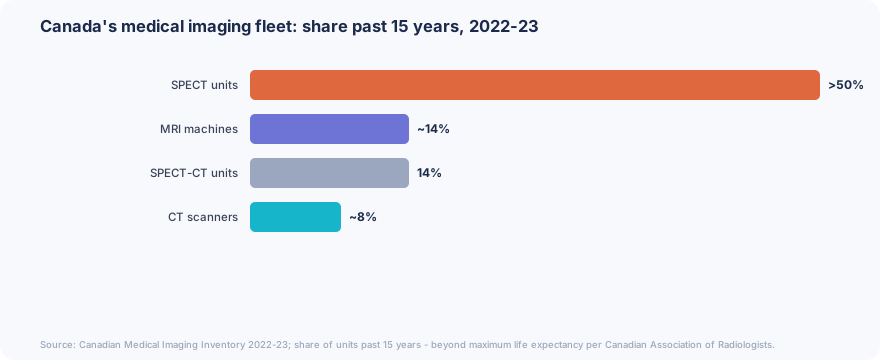
The scale is documented. A 2025 analysis of Canada's medical equipment found that more than one-third of MRI and CT scanners were older than ten years in 2022-23 - over three times the share international guidelines allow - with roughly 14% of MRI machines and more than half of SPECT units already past fifteen years, beyond their maximum life expectancy. Older equipment is less reliable, less precise, and slower; median waits reached 8.8 weeks for a CT scan and 18.1 weeks for an MRI in 2025. Aging assets are not just a capital line; they are a care problem.
New money meets an old records problem
Help is coming. Ottawa's new Build Communities Strong Fund earmarks part of its $51-billion, ten-year envelope for health facilities, and provinces are adding their own capital. But a surge of renewal money lands well only where the record is ready. Prioritizing hundreds of assets across a health authority - which scanner fails first, which building system is one failure from a ward closure, which replacement buys the most clinical risk reduction per dollar - is impossible without a current, trustworthy inventory of what exists, its condition, and its consequence. Authorities that can produce that record spend the new money where it saves the most; those that cannot spend it where the noise is loudest.
How XNM helps
XNM helps health authorities and hospital boards pull the capital-asset and facilities record into one auditable command centre - equipment inventories and service histories, condition assessments, warranty and contract files, replacement costs and clinical-risk ratings, and the capital decisions and board approvals behind them, connected and kept current. Where it helps, the XNM-Vision platform gives a CFO, a director of facilities, or a hospital board one line of sight across the whole asset base, so the replacement list is built on evidence rather than the last breakdown. When a funder or the board asks why this project and why now, the business case already exists - and because it stands up in days rather than months, the visibility arrives in time to shape the capital submission, not the post-mortem.
Practical takeaways
Treat the asset register as clinical infrastructure. An out-of-date equipment inventory quietly mis-prioritizes every capital dollar and every patient-safety risk.
Tie condition and clinical risk to the capital list. The point of a condition assessment is to drive the replacement plan; keep it where the budget is built, not in a biomed spreadsheet.
Make the business case audit-ready by default. Funders and boards will ask why this asset; keep the record in a state where the answer is already there.
Give the board one asset view. A board overseeing thousands of assets needs a single, current picture - not a binder per department.
Capture service history before the vendor changes. Maintenance and warranty knowledge should stay with the authority, not leave with a contract.
FAQ
We already have an asset management system. Isn't that enough?
An inventory is a start, but the failures happen in the gaps between systems - when condition data, clinical risk, warranty terms, and capital decisions live in separate tools that don't reconcile. The value is one current record where they update together, so the replacement list reflects the fleet as it is now, not as it was at the last audit.
Isn't this really just underfunding?
Funding is real, but visibility is the part an authority controls. New capital spent against a thin record buys less renewal - and less risk reduction - than the same money spent against a clear one. Getting the record right is how each dollar reaches the asset whose failure would hurt patients most.
The bottom line
The ten-year-old scanner is a warning about more than one machine. It is a sign that the record behind the fleet has fallen behind the fleet itself. As a rare wave of health-infrastructure money arrives, the authorities that turn it into better care will be the ones that can see their own assets - every machine, its condition, and the clinical cost of its failure - in one current, defensible record. You cannot renew what you cannot see.