Field Notes: Federal Procurement and the Paper That Proves It

In most work, the deliverable is the thing you build. In federal procurement, the deliverable is the proof that you chose fairly. A contract can be awarded to the right vendor, at a fair price, for all the right reasons - and still fail an audit, because the file couldn't show that the process was fair. The decision and the defensibility of the decision are two different products, and procurement teams live or die by the second one.
This is what makes government procurement its own world. A private buyer answers to a budget. A public buyer answers to everyone - unsuccessful bidders, oversight bodies, auditors general, and eventually the public record. The question is never just "was this a good buy?" It is "can you prove, from the contemporaneous file, that this was a fair and open process?" And you can only answer that with paper you created at the time, not paper you reconstruct under scrutiny.
What a probe is actually looking for
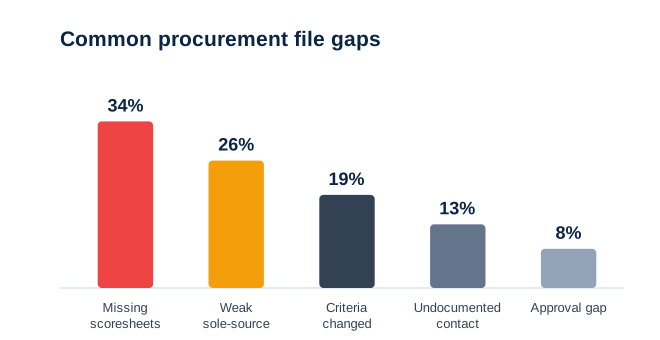
An oversight review rarely alleges corruption. Far more often it finds gaps - places where the file simply cannot demonstrate that a required step happened. The recurring soft spots are predictable:
The evaluation criteria, documented and fixed before bids were opened - not adjusted afterward to fit a preferred outcome.
The individual evaluators' scoresheets, showing how each bid was rated against those criteria.
The justification for any sole-source or limited-tender decision, written when the decision was made.
The record of every communication with bidders, so no one received an unfair advantage.
The approval chain, showing the award was authorized at the right level.
Notice the pattern: every item is something that had to exist before or during the process. None of it can be credibly created afterward. That is the entire logic of a defensible procurement file - it is contemporaneous or it is worthless.
Build the file as you go, not at the end
The teams that survive a probe don't have better memories or better lawyers. They have a habit: they treat the procurement file as something they build continuously, one dated entry at a time, from the moment a requirement is defined to the moment the contract is signed. The evaluation criteria are locked and stored before the tender closes. Scoresheets are captured the day evaluations happen. Every bidder question and answer is logged. Nothing waits for "later," because later is exactly when the file gets thin.
The reward is quiet but real. When the review comes - and in federal procurement it eventually comes - the answer to every question is already sitting in the file, dated and complete. The probe becomes a formality instead of a scramble. The team that documented as it went isn't defending a decision; it's simply handing over the evidence it built along the way.
For public buyers, that is the whole discipline in one line: the fairness of a procurement is only as real as the file that can prove it. Build the file, and the decision defends itself.
The same principle runs through every sector we cover - read more field notes here.