One Chart: Capital Spend vs. Records Maturity

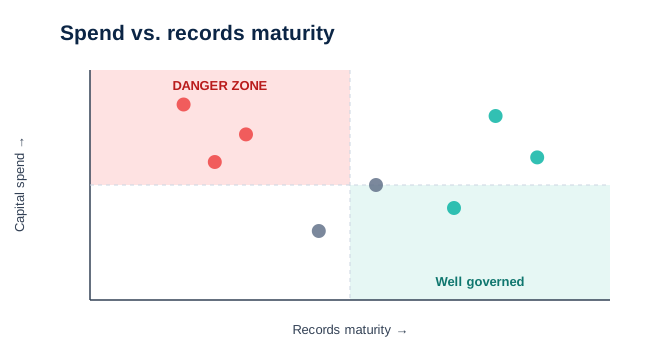
Two organizations can spend the same fifty million dollars on capital projects and carry completely different amounts of risk. The difference isn't the size of the budget or the complexity of the build. It's a quieter variable: how mature their records practices are relative to how much they're spending. Plot those two things against each other and a danger zone appears in one corner of the chart - high spend, low maturity - and almost every capital-project disaster you've read about lives there.
This article is one chart and the argument it makes. The claim is simple: risk isn't driven by spend alone, or by records alone. It's driven by the gap between them. And the gap is widest, and most dangerous, exactly where organizations grow their spending faster than they grow their ability to account for it.
Reading the four quadrants
Put records maturity on the horizontal axis - from ad hoc folders on a shared drive at the left, to a disciplined, single source of truth at the right. Put annual capital spend on the vertical axis, low to high. That gives you four zones, and each behaves differently:
Low spend, low maturity. Messy, but survivable. There isn't enough money in motion for a records gap to become catastrophic.
Low spend, high maturity. Over-invested in process for the stakes, but safe. Rare, and rarely a problem.
High spend, high maturity. The goal. Big budgets, matched by the discipline to account for every dollar and decision.
High spend, low maturity. The danger zone. Large sums moving through a system that can't reliably show where they went or who approved them.
Why the danger zone is where overruns are born
In the red corner, the failures you've seen elsewhere in this series all become likely at once. Invoices get paid without matching a commitment. Change orders lose their paper trail. Approvals can't be reconstructed. A single departure erases months of context. None of these is a spending problem - the money was available. They are accountability problems, and they cluster in the red zone because that's where the volume of decisions has outrun the system meant to record them.
The practical takeaway is a diagnostic, not a lecture. Find your organization on this chart honestly. If your spend has climbed - a bigger capital plan, more concurrent projects, larger contracts - ask whether your records maturity climbed with it. If it didn't, you haven't just grown; you've drifted toward the red corner, and the risk is already priced into your next audit whether you've felt it yet or not. The fix isn't to spend less. It's to move right on the chart, deliberately, until your ability to account catches up with your ability to commit.
Moving right is not a software purchase; it's a sequence of small commitments. Give every project a single place where its contracts, approvals, and decisions live, so there is one answer to "where is it?" Make one person accountable for that record on each project, not the whole team vaguely. And measure maturity the way you measure spend - if the capital plan grows twenty percent this year, the records discipline behind it has to grow with it, or the gap simply widens. Organizations that treat maturity as something they schedule, rather than something they hope for, are the ones that keep both dots in the safe corner as they scale.
The story that motivated this chart is worth reading next - start with the anatomies of an overrun.