The Board Minute That Wasn’t

The board approved the lease in November. Everyone remembered the discussion - the debate about the second location, the show of hands, the quiet relief when it passed. Eight months later, when a funder asked for the minutes documenting that decision, there was nothing. A calendar invite, a scatter of emails, and a shared memory. No motion. No minute. No record that the board had ever formally decided anything at all.
The lease itself was fine. The organization was fine. But for three weeks a well-run non-profit could not prove that its own governing body had authorized a six-figure commitment - and that gap, not the lease, is what nearly cost them the grant. This is the story of how a decision everyone remembers becomes a decision no one can prove, and why the fix is smaller than the fear.
A vote is not a record
Here is the distinction that trips up good boards: a decision has two separate lives. There is the moment it happens - the conversation, the vote, the nod around the table. And there is the record of it - the single written line that says, on this date, this body resolved this thing. Boards are excellent at the first and careless about the second, because the first feels like the real event and the second feels like paperwork.
But an outside party - a funder, an auditor, a regulator, a court - was not in the room. They cannot see the nod. To them, a decision that isn't written down did not happen. That is not a technicality; it is the entire basis of governance. The board's authority to bind the organization exists only to the extent it can be shown, and the minute is how you show it.
Why good boards skip the minute
Nobody decides to skip the record. It erodes quietly, and almost always for the same handful of reasons:
The discussion was the deliverable. Everyone left feeling the decision was made, so writing it down felt redundant.
The secretary was also participating. The person meant to capture the minute was busy debating the motion, and caught none of it verbatim.
The motion was never actually worded. The board reached consensus without anyone stating a clean, recordable resolution to vote on.
Minutes get drafted weeks later. By the time someone writes them up, the exact wording, the seconder, and the vote count are already fuzzy.
No one signs or approves them. Draft minutes sit in a folder, never adopted at the next meeting, so they carry no weight.
Notice that none of these is a character flaw. They are process gaps. And because the gap only becomes visible the day someone asks for proof, boards can run for years before they discover the record was never really there.
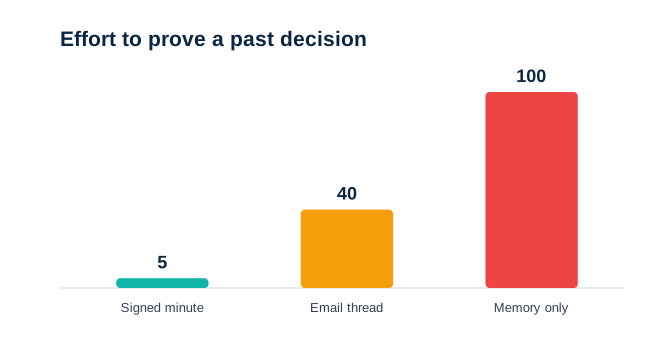
The fix is smaller than the fear
You do not need a governance overhaul. You need three habits, and none of them adds more than a few minutes to a meeting:
Word the motion out loud before the vote - a single sentence starting "Be it resolved that..." - so there is something clean to record.
Capture the resolution, the mover, the seconder, and the outcome in real time, not from memory afterward.
Adopt the prior meeting's minutes as the first agenda item every time, so every decision is formally confirmed within weeks, not left as an unapproved draft.
Do those three things and a board decision stops being a memory and becomes an asset - a dated, adopted, retrievable record that a funder, an auditor, or a successor board can rely on years later. The organization in this story now records a clean resolution for every material decision, and their last grant renewal took the file at face value.
This is exactly the kind of quiet governance gap XNM-VISION was built to close: decisions captured as durable, searchable records the moment they're made, so "everyone remembers it" is never your only evidence.
A decision no one can prove is really just an overrun waiting for its trigger - more anatomies of an overrun are here.