Funded, Not Yet Delivered: Why Provincial Capital Programs Live or Die on the Record
For a generation, the story of public infrastructure was scarcity: not enough money for the roads, transit, water systems, hospitals, and schools a growing country needs. That story is changing. Ottawa and the provinces have committed an extraordinary amount of capital, and much of it will be delivered not by departments but by provincial agencies and Crown corporations built to move projects. The binding constraint is shifting from how much money to whether the organizations spending it can prove, on demand, what each dollar bought. Delivery, it turns out, is a records discipline as much as an engineering one.
A Crown corporation or provincial agency delivering a capital program is accountable in every direction at once. It answers to a minister and a board for value for money, to the auditor general for how public funds were spent, to the legislature and the public for transparency, and to the federal funder whose transfer agreements come with reporting conditions. Satisfying all of them means being able to show, for every project, what was approved and by whom, what it was scoped and budgeted to cost, what changed and why, and what was actually delivered. When that evidence is scattered across program teams, consultants, and finance systems, each report becomes a scramble - and the scramble is where credibility, and future funding, quietly leaks away.
Recent context
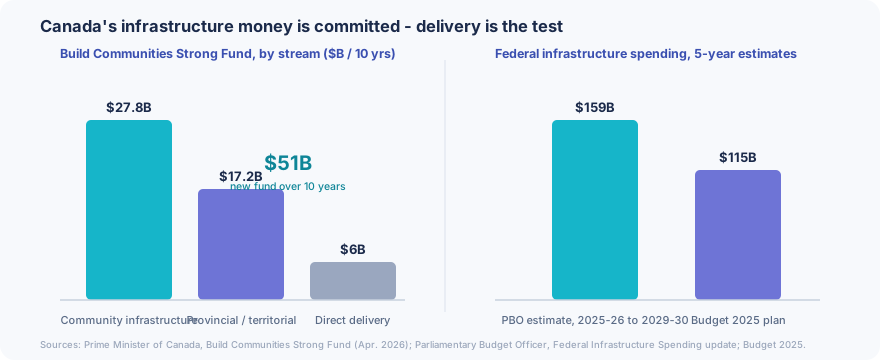
The scale is unprecedented. The Parliamentary Budget Officer estimates that the federal government will spend roughly $159 billion on infrastructure between 2025-26 and 2029-30, and Budget 2025's Build Communities Strong Fund alone commits $51 billion over ten years - $17.2 billion of it through a provincial and territorial stream for housing-enabling infrastructure, hospitals, and colleges. Much of this flows through intergovernmental agreements whose next payment depends on documented progress. The money is real; so are the strings attached to it.
The next tranche is released against the last one's record
Funding at this scale does not arrive all at once. It arrives in tranches, milestones, and cost-shared claims, each conditional on evidence that the prior commitment was met. An agency that can produce a clean, current record - approvals, budgets, change history, and delivery proof, tied to each project - moves smoothly from one payment to the next. One that cannot spends its energy reconstructing what happened, misses reporting deadlines, and gives a funder or an auditor reason to slow the flow. The reputational cost compounds: the organization that reports cleanly this year is trusted with the larger mandate next year, while the one that stumbles finds its programs scrutinized, delayed, or reassigned. In public capital delivery, the record is not paperwork after the work - it is the thing that keeps the work funded.
How XNM helps
XNM helps provincial agencies and Crown corporations bring the whole capital-program record into one auditable command centre - approvals and mandates, budgets and forecasts, contracts, change orders, milestone claims, and delivery evidence, organized by project and portfolio and kept current. Where it helps, the XNM-Vision platform gives an executive team, a board, or a funder-facing group one line of sight across every project at once, so a progress claim, an audit request, or a legislative question is answered from a record that already exists. When the next tranche depends on documented delivery, the documentation is already there - and because it stands up in days rather than the months a records overhaul usually takes, the readiness arrives in time for this funding cycle, not the next.
Practical takeaways
Treat the record as a condition of funding. At this scale, money moves in tranches against evidence; a clean, current file is what keeps the next payment on schedule.
Report from one source, not a quarterly scramble. If every progress claim and audit means reassembling the story, you are paying a tax on your own credibility.
Tie approvals, budget, and delivery together. A funder and an auditor test the whole chain - what was approved, what it cost, what changed, and what was delivered - so keep it in one place.
Give the board and the funder the same view. Transparency is cheaper when everyone reads from the same current record instead of a curated snapshot.
Build for the audit you will certainly face. Public capital is audited by default; keep every project file complete and defensible from day one, not reconstructed on request.
FAQ
We report to our funders every quarter already. Isn't that the record?
A report is a snapshot; the record is what the snapshot is drawn from. When the report and the underlying evidence live in different places, each reporting cycle becomes a reconciliation exercise, and an auditor's follow-up question can take weeks to answer. The value is a living record the report is generated from - so the numbers are consistent and the backup is always one click away.
Our projects are delivered by different teams and consultants. Can one record really span them?
That is exactly the case for one record. When each team and consultant keeps its own file, the agency owns none of them, and institutional memory leaves with every contract. A single governed record means the organization - not its vendors - holds the complete, current picture of what it is delivering and what it has delivered.
The bottom line
The era of infrastructure scarcity is giving way to an era of infrastructure delivery, and the agencies that thrive in it will not simply be the ones that receive the most money. They will be the ones that can prove what they did with it. In a world where the next tranche is released against the last one's record, delivery and documentation are the same discipline - and the organizations that master it will be trusted to build the most.