The Data Room Decides the Deal: Why a Developer's Record Is Its Financing
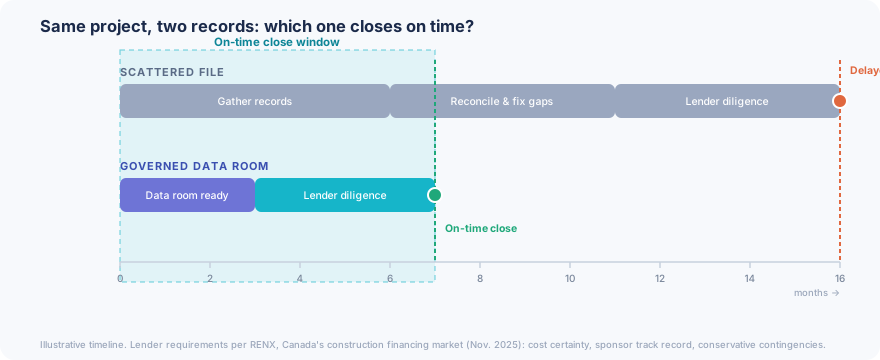
Two developers bring similar projects to the same lender in the same month. One walks in with a complete, current data room - title, permits, pro forma, budget, contracts, consultant reports, and a clean track record, all organized and reconcilable. The other has most of it, somewhere, across email threads, a shared drive, and three consultants' inboxes. The first is in diligence within a week and closes on schedule. The second spends the first half-year assembling and reconciling documents before the lender can even begin. Same market, same merits - and one project is funded while the other is still hunting for a permit. The difference is the record.
Development is a documentation business wearing a hard hat. A developer or owner-operator carries land and title records, zoning and permit approvals, pro formas and budgets, construction and consultant contracts, change orders, insurance and warranty files, and lender and investor reporting - multiplied across every project in the portfolio and every stage from acquisition to stabilization. When that record is scattered, the cost shows up at the worst possible moment: in the financing window, when a lender's diligence stalls on a missing document; at sale or refinancing, when a buyer's data-room request exposes the gaps; and in a dispute, when the file that would settle it cannot be produced. In each case the asset is only as strong as the record behind it.
Recent context
The market has raised the bar. An analysis of Canada's construction financing market in late 2025 describes lenders prioritizing projects with cost certainty, sponsors with demonstrable execution track records, and conservative contingencies - with developers now fixing 70% or more of hard costs upfront before financing. In a cautious lending environment, capital flows to the sponsor who can prove the project is real and under control. Proving it is a documentation exercise as much as a design one.
The record is the financing
It is tempting to think of the data room as something you assemble at the end, once the deal is real. But the developers who close fastest treat the record as a live asset built as the project goes - so that at any moment, the file needed for a lender, a buyer, a partner, or an auditor already exists. This is not just about speed, though speed matters when a rate lock or a construction season is on the line. It is about leverage: a sponsor who can answer every diligence question immediately negotiates from strength, while one who is visibly scrambling invites tougher terms. And it compounds across a portfolio - the developer whose first project's record was clean carries that credibility, and that reusable discipline, into every deal after it.
How XNM helps
XNM helps developers and owner-operators bring the whole project and portfolio record into one auditable command centre - land and title, permits and approvals, pro formas and budgets, contracts and change orders, consultant reports, and lender and investor reporting, organized by project and kept current. Where it helps, the XNM-Vision platform makes the financing-ready data room a byproduct of running the project rather than a fire drill before a close - so a diligence request, a refinancing, or an investor update is answered from a record that already exists. The aim is not another drive to search; it is the single governed file the deal depends on - stood up in days, not the months a document cleanup usually takes when the clock is already running.
Practical takeaways
Build the data room as you go, not at the close. The file a lender needs should already exist the day you decide to finance; assembling it under a rate lock is how deals slip.
Keep the whole chain per project. Title, permits, budget, contracts, and change orders belong together - a gap in any one is where diligence stalls.
Treat a clean record as negotiating leverage. A sponsor who answers every question immediately gets better terms than one who is visibly scrambling.
Own the file, not just the buildings. When each consultant holds its own records, you own none of them; the portfolio's memory should live with the owner.
Make it reusable across the portfolio. The documentation standard that closed your last deal should make your next one faster, not start from scratch.
FAQ
Our lenders send a document checklist. Isn't that enough to organize around?
A checklist tells you what the lender wants at the end; it does not keep the underlying record current as the project moves. Deals stall not because the checklist is unknown but because the documents behind it are scattered, out of date, or contradictory when it is time to produce them. The value is a live record so the checklist is a formality, not a scramble.
We only run a few projects at a time. Do we really need this?
A lean shop feels a scattered record most acutely, because there is no back office to absorb the scramble. When a financing window opens, the small team either has the file ready or loses days it does not have. A single current record is how a small developer moves at the speed the market demands.
The bottom line
In a market where lenders want proof, not promises, the data room is not paperwork around the deal - it is the deal's readiness made visible. The developers who consistently close are the ones whose record is never in doubt, because they built it as they built the project. The site gets a project noticed; the record gets it financed.