How to Audit Your Own Project Before Someone Else Does

An external auditor is not smarter than you about your own project. They have never walked the site. They do not know which of your subcontractors is reliable or which change order everyone argued about for a month. They have exactly one advantage, and it is decisive: they are not tired of your project, so they will actually open the folder and read what is in it.
That is the whole trick, and it is available to you at any time, for free. The only difference between your version and theirs is timing, and timing is worth more than everything else on the list.
Five questions, and only five
You do not need an audit methodology. You need to pick five files at random and ask the same five questions an auditor will ask about each of them. If the file cannot answer, you have found something, and you have found it while it is still cheap.
Who approved this, and can you show me? Not who would have approved it. The record: a name, a date, and a document that existed before the money moved.
Was the person who approved it allowed to? Match the amount against your delegation of authority. This is the single most common finding, and almost nobody checks it on themselves.
Does the paid amount match the approved amount? Not roughly. Exactly, or with a documented reason for the difference sitting beside it.
Can you produce it without asking anyone? If finding it requires a phone call to a person who has left, the record does not exist yet. It is a memory with a filename.
Would it still make sense to a stranger in three years? Read it as if you know nothing. Acronyms, half-sentences and pricing logic that only lived in someone's head all fail this test.
Five files, five questions, roughly two hours. Do it quarterly. The point is not the twenty-five answers; it is the pattern in the failures. One bad file is an accident. The same question failing on four out of five files is a process telling you exactly where it leaks.
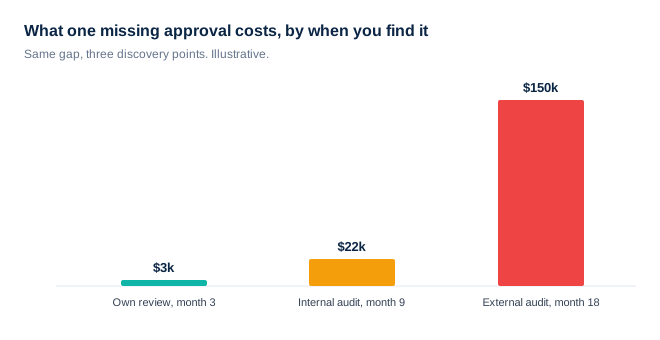
Why the timing is the whole value
In month three, a missing approval is a two-email problem. The person who made the decision is still on the project, still remembers the reasoning, and can sign a note confirming it. The correction costs a coffee and a calendar entry.
In month nine, that same gap has become a small archaeology project. The decision-maker has moved to another file, the reasoning has to be reconstructed from fragments, and someone senior now has to decide whether reconstructing it is even defensible.
In month eighteen, found by someone else, it is no longer a gap. It is a finding. Findings travel upward, attach themselves to your organisation rather than to the file, and generate work that has nothing to do with building anything: responses, corrective action plans, follow-up reviews, and a paragraph in a report that will outlive everyone who wrote it. The gap did not grow. Its price did, because you lost the ability to fix it quietly.
Start with the boring files
There is a temptation to test the biggest, most complicated file you have. Resist it. Big files get attention; that is why they are usually fine. The gaps live in the routine transactions nobody thinks twice about, which is also where an auditor will sample, because random sampling has no respect for how important you thought a transaction was.
Pick five at random this week. Ask the five questions. Write down what you could not answer, and fix the process rather than just the file, because the file was never the problem.
The organisations that never seem to be surprised by audits are not luckier than anyone else. They simply found everything first, on a quiet Tuesday, at a fraction of the price. If you want more on making a project answer questions before someone else asks them, the rest of the series goes file by file.