Field Notes: Provincial Megaprojects and Document Governance
A large provincial build can receive more documents in a single month than a small municipal project generates in its entire life. That is not a metaphor. It is the practical fact that reorganises everything, and the reason methods that worked beautifully on a twelve-million-dollar recreation centre quietly collapse on a nine-figure one.
Nothing dramatic marks the transition. The team is more experienced, not less. The failure, when it arrives, is never a lost document. It is the moment somebody asks which version of a drawing the crew built to, and four honest people give three different answers.
Volume changes the nature of the problem
At small scale, document control is a filing question, and good people solve it with good habits. At megaproject scale, it becomes a governance question, because no individual can hold the state of the project in their head any more. Once that threshold is crossed, habits stop scaling and only rules do. The awkward part is that the threshold is invisible while you are crossing it, and obvious only in hindsight, usually during a dispute.
The provincial projects that handle this well tend to have decided four things before the volume arrives, not after.
One authoritative source per document type, named in writing. Not one system for everything, which never survives contact with the consultants. One named place per class of record, and an explicit statement that copies elsewhere are copies.
A transmittal discipline with teeth. If it did not come through the transmittal process, it is not issued information, no matter who emailed it or how senior they are.
A delegation of authority everyone can actually see. Written thresholds, published, matched to the approvals in the system, so that authority is checkable rather than assumed.
Retention obligations settled at day one. Public works carry statutory retention that outlives the contractor, the software licence and often the department. Decide the destination early, while it is still a design choice.
Closeout is where governance gets its bill
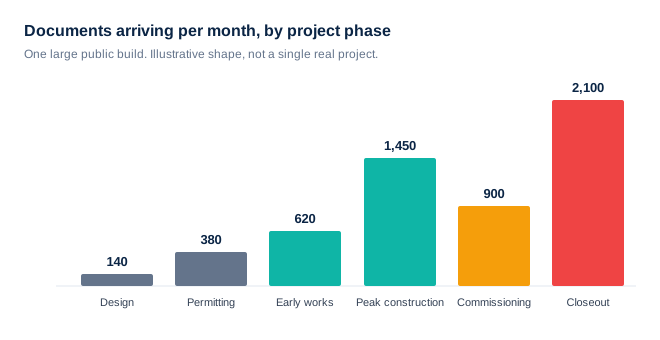
Look at the shape of that chart. Almost everyone staffs document work for the construction peak, which is intuitive and wrong. The heaviest month is closeout, when as-builts, warranties, operating manuals, testing records, permits, releases and final certificates all arrive at once, from parties whose contracts are ending and whose interest in your file structure is ending with them.
A project with governance treats that as a heavy but ordinary month. A project without it discovers that the warranty package is incomplete two years later, when a roof leaks and the answer to who is responsible depends on a document that was never transmitted, only mentioned.
What this looks like on a Monday
None of this requires a task force. It requires four decisions written down and enforced early, when writing them costs nothing. The organisations that skip it are not careless; they are busy, and the cost of skipping is invisible for the first year and then arrives all at once, in a dispute, with lawyers translating your filing habits into liability.
It is also worth being honest about what tooling does and does not solve here. Software can enforce a rule you have already made, and it can make a record findable years later. It cannot decide who is allowed to approve what. XNM-VISION exists to hold the record and the reporting in one place, but the four decisions above have to belong to your organisation, because they are governance, not features.
The gap between a well-run small project and a well-governed large one is smaller than it looks, and it is mostly made of decisions taken early. For more field notes on how that plays out across sectors, the rest of the series is worth a scroll.