Doubling the Grid Means Doubling the Records: The Utility's 40-Year Test
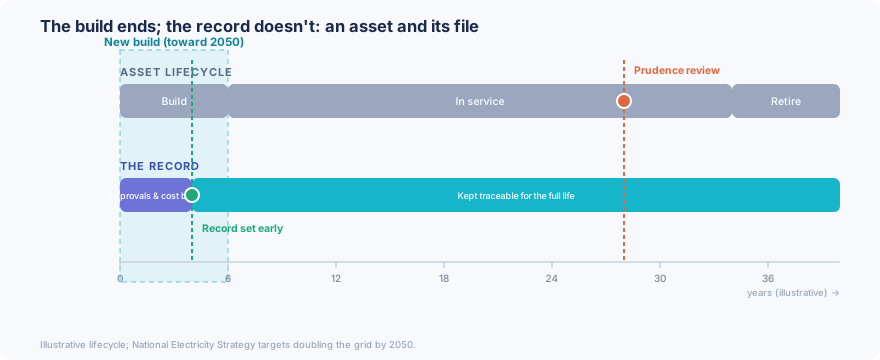
A regulated utility lives a double life. It builds physical assets - transmission lines, substations, generating stations - that can stay in service for forty years or more. And it builds a parallel asset that almost never gets the same attention: the record behind each of those assets. The approvals, the cost basis, the engineering decisions, the prudence justification - the documentation a regulator will one day want to see to let the utility recover its investment from ratepayers. The steel goes up in a few years. The obligation to prove it was prudent lasts as long as the asset does.
That gap between build time and record time is where utilities quietly accumulate risk. The team that built a substation in 2026 will be long gone when, in 2046, a rate case or a prudence review asks exactly why it cost what it did and whether ratepayers should still be paying for it. If the only memory of that decision lives in a project folder on a decommissioned server, or in the head of an engineer who retired a decade earlier, the utility is exposed at the worst possible moment. A regulated business recovers what it can prove - and proof is a records discipline, not a construction one.
Recent context
The volume is about to climb steeply. In May 2026 the federal government announced a National Electricity Strategy aimed at roughly doubling Canada's electricity grid by 2050, with new East-West-North transmission lines, major projects from the Taltson and Iqaluit hydro expansions to the North Coast Transmission Line, and a workforce of 130,000-plus to build it. Doubling the grid means doubling the assets - and doubling the asset records each one drags behind it across a service life measured in decades.
Why scale turns a habit into a liability
At today's pace, a utility can manage asset records the way it always has, with each team keeping its own files. Double the project volume and that approach breaks. More assets mean more concurrent regulatory filings, more cost bases to substantiate, and far more documentation entering a 40-year retention window. The weakest part of a utility's record-keeping - the project whose file was never properly closed, the change order no one can locate - does not stay a small problem when it surfaces in a hearing two decades later. The cheapest moment to get the record under control is before the buildout, not after a prudence challenge has already found the hole.
How XNM helps
XNM helps utilities and energy-infrastructure owners hold the capital and asset record in one auditable command centre - approvals, engineering, cost basis, contracts, change orders and asset history tied together and kept current across the full service life. Where it helps, the XNM-Vision platform lets a regulatory team assemble a rate-case or prudence file from a traceable record rather than reconstruct it from fragments years later, and gives leadership one portfolio view across every project competing for capital and crews. Because it deploys in days, a utility can get control of the record ahead of the buildout - not after the gaps have already cost real money.
Practical takeaways
Set the record when you build, not when you're challenged. The cost basis and decisions captured at construction are what you defend decades later; reconstruction is expensive and incomplete.
Design for a 40-year retention window. Assets outlive their teams; the file has to carry the why and the cost long after the builders are gone.
Keep rate-case evidence traceable. A filing assembled from a governed record is faster and far easier to defend than one rebuilt from scattered drives.
Scale the records before the capital. Doubling project volume strains the weakest part of your documentation first - fix it ahead of the wave.
Give leadership one portfolio view. When many projects compete for the same capital and crews, you need a single line of sight, not competing decks.
FAQ
We have an asset-management system. Isn't the record already handled?
An asset register tells you what you own and where; it does not always carry the governed, traceable file behind each asset - the approvals, cost basis and decisions a regulator wants to see. The gap utilities hit in a rate case is provenance, not inventory, and that is the part a 40-year build cycle punishes hardest.
Our capital plan is large but steady. Why change now?
Because the buildout ahead is not steady - it is accelerating toward 2050. The least expensive time to bring the record under control is before the volume doubles, not after a prudence review has exposed the gaps. Readiness costs far less than reconstruction.
The bottom line
The grid Canada is about to build will be measured in lines, stations and megawatts - but the money behind it will be won or lost in the records. A utility recovers what it can prove and risks what it cannot trace, and the proof has to survive a service life measured in decades. As the grid doubles, the owners who keep every asset tied to the file behind it are the ones who will actually earn a return on what they build.