A Field Guide to Contract Administration That Holds Up

A contract isn't finished when it's signed. That's when it starts. The signature is the easy part; administering the contract - the months of changes, claims, payments, and approvals that follow - is where the money is won or lost. And it's the part almost everyone improvises.
Here is the promise: by the end of this you'll have a contract-administration routine that protects you a year from now, when a dispute lands and someone asks for the documentation. The teams that win those moments aren't lucky. They administered the contract on purpose.
What contract administration actually is
Contract administration is the discipline of managing a signed agreement through its life: tracking what was promised, recording what changed, tying every payment to a deliverable, and keeping the paper trail that proves it. It isn't legal work and it isn't accounting - it's the connective tissue between them. Done well it's nearly invisible. Done badly it's the reason a routine change order turns into a six-month argument.
The five questions a contract file must always answer
Open your most important contract's file right now. If it can't answer these five questions on its own, you have found tomorrow's problem today.
What did we agree to? the executed contract, scope, schedule of values, and key dates - the baseline everything else is measured against.
What changed? every change order, amendment, and approval, in sequence, with who authorized it and when.
What's been delivered? milestones met, work accepted, deliverables received - the evidence behind each payment.
What's been paid? invoiced-to-date and paid-to-date against the contract value, so you always know what's left.
What's in dispute? open claims, notices, and unresolved items, with the correspondence that supports your position.
Administer it as you go, not at the end
The fatal mistake is treating administration as cleanup - something you'll sort out when the project closes. By then the people have moved on, the emails are buried, and the timeline is a guess. Records made at the moment carry weight; records reconstructed later carry doubt. A change noted the day it happened is evidence. The same change remembered eight months later is an argument.
The discipline is small and daily: when something changes, write it down, attach the approval, and file it against the contract - not in a personal inbox. That's it. Done consistently, it's the difference between a file that holds up and a file that falls apart.
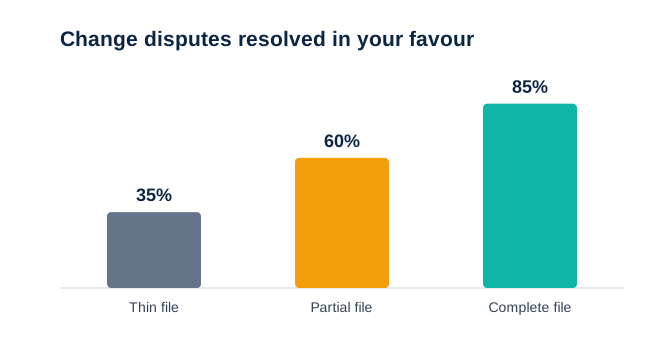
The chart is illustrative, but the relationship is real and intuitive: a complete, contemporaneous file gives you the high ground in almost any dispute, while a thin one leaves you negotiating from memory. Documentation doesn't just record the deal - it decides who wins the argument about it.
A routine that survives turnover
The best test of contract administration is whether it survives the person who set it up leaving. If the answer to where's the documentation depends on one employee's habits, you don't have a system - you have a single point of failure.
One home per contract. the agreement and everything that touches it in one place, not scattered across drives and inboxes.
Date and attribute everything. every change shows who approved it and when - no anonymous edits, no undated notes.
Review monthly, not at closeout. a fifteen-minute monthly check keeps the file current and surfaces problems while they're still cheap.
Tomorrow morning, pick your most important active contract and answer the five questions above from its file alone. If you can't - if you need to call someone or dig through email - you've just found the gap a dispute will exploit. Close it now, while it's quiet.
Contract administration and clean invoicing are two halves of the same habit - we broke down how the two connect over here.