58,000 Beds and Counting: Why Long-Term Care Construction Is a Records Discipline
There is a bed on a funding announcement and there is a bed a resident actually moves into, and the distance between the two is measured in records. A long-term care home does not open because the money was promised; it opens because a rezoning was approved, a design met the ministry's standards, a construction contract closed, thousands of inspections and change orders were tracked, and a licence was granted against a file that proved every requirement had been met. Miss a document and the bed sits empty past its promised date. For the health authorities and operators building at scale right now, the construction record is not the paperwork around the project. It is the project.
Long-term care construction is one of the most records-dense capital projects a public-facing organization takes on. A single home carries land and zoning approvals, ministry design submissions, funding agreements with detailed draw and reporting conditions, a full set of drawings and their revisions, environmental and accessibility compliance, construction contracts and change orders, commissioning documents, and the licensing and inspection record that governs the day it can accept residents. Now multiply that by a portfolio of homes advancing at once, on staggered timelines, often through different contractors and consultants. When each build's record lives in a different inbox, drive, or binder, the program office is flying blind on the one question that matters: which bed is truly on track, and which one is quietly slipping.
Recent context
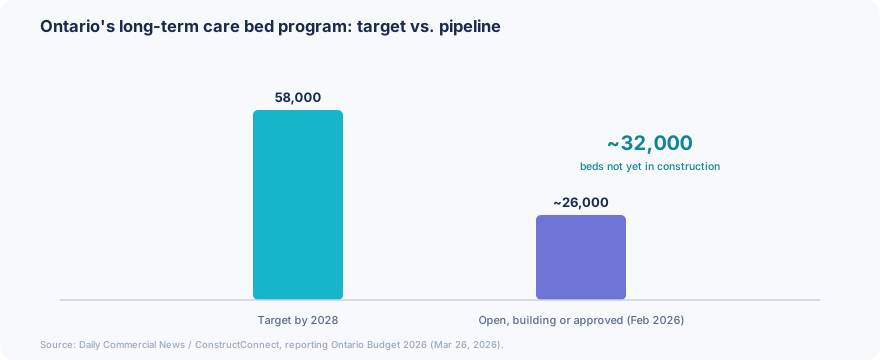
The demand is not abstract, and neither is the build-out. The Daily Commercial News reported in March 2026, drawing on Ontario's 2026 budget, that the province is aiming for 58,000 new or upgraded long-term care beds by 2028 - with roughly 26,000 open, under construction, or approved to start as of February 2026, and officials acknowledging the original deadline is now unlikely to be met. The same budget added $1.1 billion for home care. The bed target is enormous, the pipeline is real, and the gap between the two is where records discipline either holds a program together or lets it drift.
Every bed is a compliance record before it is a room
It is tempting to treat this as a construction-capacity story - not enough shovels, not enough trades. Capacity is real, but it is not the whole picture. A long-term care bed cannot be occupied until a chain of records is complete and defensible: the design was approved, the build conformed, the systems were commissioned, and the home passed inspection and licensing. A gap anywhere in that chain delays occupancy no matter how finished the building looks. And the pressure behind the program is only growing.
The Canadian Institute for Health Information noted in February 2026 that more than 250,000 Canadians already live in long-term care, with demand expected to grow over the coming decade. Every year of delay on a bed is a year of a waitlist that does not move - which is exactly why the organizations delivering these homes cannot afford a construction record they cannot see or trust.
How XNM helps
XNM helps health authorities and long-term care operators pull the entire build record into one auditable command centre - approvals, funding agreements and their reporting conditions, drawings and revisions, contracts, change orders, commissioning, and the inspection and licensing file - organized by project and kept current across the whole portfolio. Where it helps, the XNM-Vision platform gives a capital-planning director a single line of sight over every home in flight, so the status of each bed rests on evidence rather than the most recent phone call. When a funder asks whether a draw condition was met, or a ministry asks for the compliance record before licensing, the answer already exists in a defensible form. And because it stands up in days rather than the many months a records overhaul usually takes, the visibility arrives in time to protect the opening date, not to explain why it slipped.
Practical takeaways
Treat the licensing file as the finish line, not an afterthought. A bed opens on its inspection and licensing record; build that file as you go so the last step is a formality, not a scramble.
Tie funding conditions to the evidence that satisfies them. Draw schedules and reporting requirements are records obligations - keep the proof attached to the project, not buried in an email thread.
Give the program office one portfolio view. A dozen homes on staggered timelines need a single, current picture of which is on track and which is slipping - not a status call per project.
Keep drawings and change orders under one current record. Rework and disputes on a health-care build are expensive and slow; one authoritative set per home keeps the field building the right thing.
Capture the build record for the operating decades ahead. The as-builts, warranties, and commissioning data you file now are what the home will rely on for maintenance and future renewal - don't let them scatter at closeout.
FAQ
Isn't this really a construction-capacity problem, not a records problem?
Capacity matters, but a finished building is not an open bed. Occupancy waits on a complete, defensible record - approvals, commissioning, inspection, licensing. The organizations that open on time are the ones whose record keeps pace with the concrete, so the final approvals meet a file that is already ready.
We manage each project with its own contractor and tools. Why centralize?
Because the program - not any single project - is what leadership and funders are accountable for. Project-level tools tell you about one home; a portfolio needs one current view across all of them. Centralizing the record is how a capital-planning office answers 'which beds are truly on track' without a week of phone calls.
The bottom line
A 58,000-bed target is a governance challenge before it is a construction one. The beds that open on time are the ones whose record never fell behind the build - funding, design, and inspection tied together and visible in one place. You cannot open a bed you cannot prove is ready, and the record is how an operator proves it.