Why "We Know Where Everything Is" Is a Myth

Ask any team whether they can find their documents and you will get the same confident answer: of course, we know where everything is. It is one of the most common sentences in working life, and one of the least examined. Nobody is lying when they say it. They simply have never been forced to prove it, until the day someone is.
That day always comes. An auditor asks for a specific record. A lawyer requests every document touching a dispute. A funder wants the approval behind a particular spend. And suddenly the comfortable belief, we know where everything is, meets the only test that matters: can you put your hand on it, now, in its current version? The gap between the belief and the answer is where organizations quietly get hurt. By the end of this you'll see why the confidence is real and the claim is still false.
Why the confidence feels true
The belief is not irrational. On an ordinary day, people do find what they need, because on an ordinary day they are looking for recent things they touched themselves and broadly remember. That daily success is what fuels the confidence. But it is a biased sample. It tests the easy retrievals, the file from last week, the email you sent, and never the hard ones: the decision from three years ago, the document a departed colleague owned, the version that proves what was true on a specific date.
So the confidence is built entirely on the cases that were never going to be a problem. The cases that hurt you, the old, the orphaned, the disputed, are exactly the ones daily life never asks you to retrieve. You feel findable because you have only ever tested findability on the easy questions.
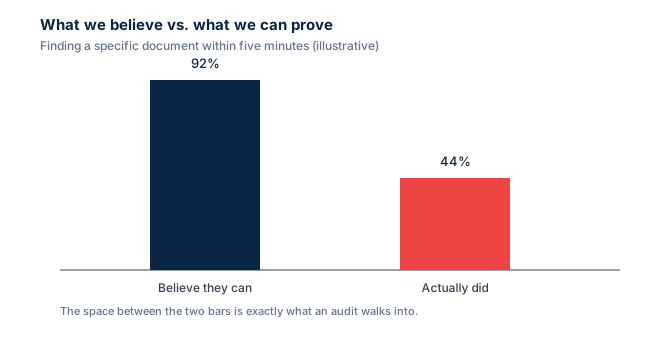
The two bars tell the story. Nearly everyone believes they can find a given document quickly. Far fewer actually do when a stopwatch is running and the document is one that matters. The space between those bars is not incompetence. It is the difference between remembering and proving, and an audit lives entirely in that space.
What closes the gap
The fix is not to try harder or to scold people for disorganization. Findability is not a personal virtue; it is a property of a system. A team closes the gap when current means the same thing to everyone, when there is one controlled place a document lives rather than several plausible ones, and when retrieval does not depend on whether the right person still works there. That is what it means to be audit-ready as a resting state rather than a scramble. It is also, not incidentally, the foundation that tools like XNM-VISION exist to provide: a single place where what exists and where can be answered on demand.
This week, run the test that no one runs until they have to. Pick one document that would actually matter, a key approval, a signed contract, a decision record, and time yourself finding it in its current version. If it takes longer than five minutes, you have just measured your own confidence gap, and you have found it on a quiet Tuesday instead of in front of an auditor.
Closing this gap is what audit readiness really means - more on making ready the default instead of a fire drill, and how findable records turn an audit from a threat into a non-event.