Who Watches the Capital Plan? Crown Corporations and the Oversight Gap
Provincial governments do not build everything through a single department anymore. A large share of the roads, power, water, and public buildings a province delivers now flows through Crown corporations and arm's-length agencies - entities created precisely so they can run commercial-scale projects at a step removed from the legislature. The structure has real advantages. It also has a quiet cost: the further a capital dollar travels from the department that answers for it, the more places its record can live, and the harder it becomes for any one board to see the whole picture.
That matters because oversight of a Crown corporation is not the same as running it. A board director or an audit-committee member governs through documents - business cases, board approvals, procurement files, contracts, change orders, and the reporting that ties them to a budget. When those records are scattered across the corporation's own systems, the parent ministry's files, and the consultants who actually delivered the work, the board is left governing by summary. It sees the deck, not the deal. And a summary is exactly where a problem hides until it is too large to fix quietly.
Recent context
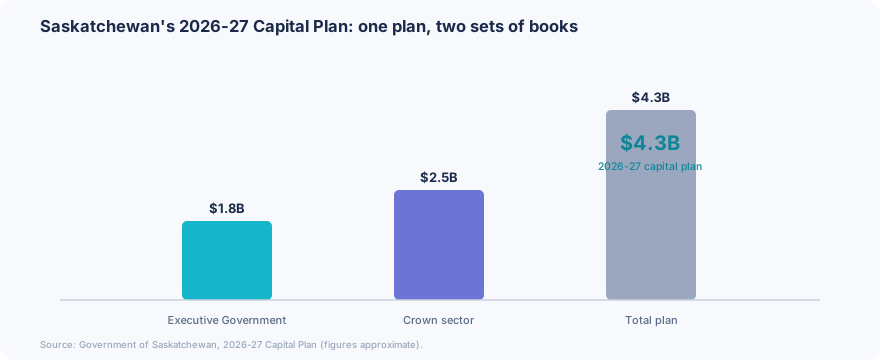
The scale is easy to underestimate. Saskatchewan's 2026-27 Capital Plan commits more than $4.3 billion in a single year - roughly $1.8 billion of direct Executive Government spending and over $2.5 billion routed through the Crown sector. More than half the plan, in other words, is delivered one structural step away from the government's own books. Every province runs some version of this split, and the Crown-sector share is consistently the part where a board's line of sight depends most on the quality of the record underneath it.
Oversight is a documents problem
The Auditor General exists in part to close this gap. As the federal Office of the Auditor General notes, its audits help legislatures, the boards of Crown corporations, and audit committees oversee the management of public activities - and an audit is only ever as good as the evidence it can reach. The same is true between audits. A board that can trace any capital dollar to the approved business case, the signed contract, and the change orders that moved it does not have to wait for a year-end finding to know something slipped. A board that cannot is governing on trust. The structural distance that makes a Crown corporation useful is the same distance that makes its record the deciding factor in whether oversight is real or ceremonial.
How XNM helps
XNM helps provincial agencies and Crown corporations pull the capital-project record into one auditable command centre - business cases, approvals, procurement, contracts, and change orders, tied to the dollars they move and kept current. Where it helps, the XNM-Vision platform gives boards and audit committees a portfolio view across every project the entity is delivering, so the running picture is visible between audits, not just at one. When the Auditor General, the shareholder ministry, or the board's own committee asks what was approved and on whose authority, the answer is already assembled. And because it stands up in days rather than the many months a records overhaul usually takes, the oversight arrives while it can still change a decision.
Practical takeaways
Govern the record, not the summary. A board that only ever sees the deck is governing what someone chose to show it; insist on traceability to the underlying documents.
Close the distance the structure creates. An arm's-length entity should not mean an arm's-length record; the owner's evidence must travel back to the board.
Make the portfolio visible between audits. The Auditor General arrives once a year; your control gaps appear every month. Watch the running total, not the year-end one.
Tie every approval to its authority. A capital commitment a board cannot trace to a board or ministerial approval is a governance gap, not a paperwork one.
Keep the corporation's institutional memory. Executives and consultants rotate; the record of why each project was approved and changed must outlast them.
FAQ
Isn't the whole point of a Crown corporation to operate at arm's length from government?
Operationally, yes - and that independence is valuable. But arm's-length operation is not the same as arm's-length accountability. The board still answers for the capital it deploys, and answering requires evidence the board can actually reach. Distance in management should never mean distance in the record.
We already get quarterly reports from the corporation. Isn't that oversight?
Reports are an output of oversight, not a substitute for it. A quarterly report tells you what management chose to summarize; governance is being able to test that summary against the documents behind it when something looks off. The report is the headline; the record is the story.
The bottom line
When a province delivers half its capital plan through Crown corporations, oversight stops being about effort and starts being about evidence. The boards that genuinely govern these entities are the ones that can reach the record - every business case, contract, and change order, current and traceable, no matter how many structural steps separate them from the work. A capital plan is only as governable as the documents a board can actually see.