When New Starts Slow, Your Records Run the Business: The Developer's Quiet Test

Every developer knows the feeling of a market shifting under their feet. New deals get harder to pencil, lenders ask sharper questions, and the projects already in the ground stop being one of many priorities and become the priority. In a slowdown, you cannot grow your way out of a control problem; the portfolio you already hold is the business. And the firms that come through a tighter market in the best shape are usually not the ones with the most projects - they are the ones who can actually see and govern the ones they have.
That visibility is a records problem before it is anything else. A development portfolio is a sprawling, living archive: land and title, financing and covenants, design drawings, permits, construction contracts, change orders, draw schedules, and the correspondence that explains every decision. When that record is scattered across project folders, a few key people's inboxes, and the systems of consultants who rotate on and off, an owner loses the one thing a tight market punishes hardest - the ability to know, quickly and exactly, where each project stands, what it owes, and what could move against it. A surprise you find in month nine of a downturn is far more expensive than one you saw coming in month two.
Recent context
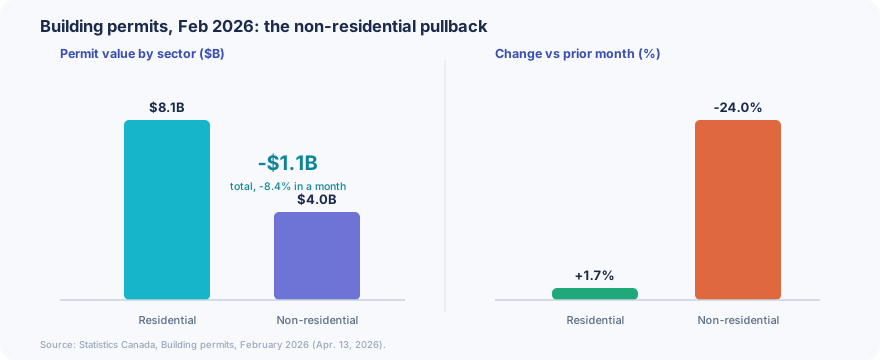
The market has clearly turned. Statistics Canada reported that the total value of building permits fell $1.1 billion (-8.4%) in February 2026, led by a 24% collapse in non-residential permits - a $1.3-billion drop and the steepest monthly decline in that category since April 2023, even as residential ticked up 1.7%. Fewer new starts mean the projects already underway carry more of the weight, and the cost of losing control of any one of them rises accordingly.
A tight market reprices control
When capital was cheap and demand was strong, a degree of disorganization was survivable; a hot market forgives a lot. A tight one does not. Every avoidable delay, every change order that slips through unpriced, every covenant breach a team did not see coming costs real money at exactly the moment money is hardest to find. The discipline that felt optional in the boom - one current, controllable record per project, and a portfolio view across all of them - becomes the difference between defending your margin and watching it erode. Downturns do not create records problems; they reveal and reprice the ones that were already there.
How XNM helps
XNM helps developers and owner-operators bring the whole portfolio into one auditable command centre - land, financing, permits, contracts, change orders and draw schedules for every project, tied together and kept current. Where it helps, the XNM-Vision platform gives principals a single portfolio view, so the status, exposure and running change-order total of each asset are visible at a glance rather than reconstructed under pressure. When a lender, a partner, or your own finance lead asks where a project really stands, the answer is already there. And because it stands up in days rather than the months a records overhaul usually takes, the control arrives while the market still gives you room to use it.
Practical takeaways
Treat the existing portfolio as the business. In a slowdown you win on the projects you already hold; their records are where margin is defended or lost.
Make every project status real-time, not reconstructed. The exposure you discover late in a downturn costs far more than the one you saw early.
Track change orders as a running total. Unpriced scope creep is pure margin erosion - watch the cumulative number, not the year-end one.
Keep covenants and deadlines visible. A breach you see coming is a conversation; a breach you miss is a crisis.
Run one portfolio view. When every asset matters more, leadership needs a single line of sight, not a stack of inconsistent project decks.
FAQ
We're a lean shop and we know our projects. Why add a system now?
Knowing your projects in your head is exactly the risk a tight market exposes - it does not survive a key person leaving, a lender's deadline, or three things going wrong at once. A controllable record is what turns personal knowledge into an asset the firm owns, right when you can least afford a blind spot.
Isn't a downturn the wrong time to invest in this?
It is the time it pays off most. The cost of disorganization is highest when margins are thin and money is dear; getting the portfolio under control is one of the few moves that protects value in a slow market rather than just chasing growth in a fast one.
The bottom line
A slowdown does not reward the developer with the most projects; it rewards the one who can see and govern the projects they have. As new starts cool, the portfolio you already hold becomes the whole game - and its records are how you keep control of it. In a tight market, the firms that can find, prove, and act on every detail of every project are the ones that come out the other side with their margins, and their reputations, intact.