Self-Government Runs on Records: Why Metis Housing Authority Is a Records Test

One of the quiet markers of self-government is who keeps the books. For decades, funding for Indigenous communities flowed with someone else's reporting template attached and someone else's filing cabinet as the final destination. The shift now underway - Metis governments administering their own housing dollars, on their own terms - changes that. It also changes where the responsibility for the record sits. When you control the money, you also own the obligation to show, credibly and on demand, where it went. Authority and accountability arrive together.
That is not a burden to resent; it is the substance of self-determination. But it is real work. A housing program generates a long, living record - applications, eligibility decisions, construction contracts, inspections, repair histories, and the financial reporting that ties each dollar to a home. Held well, that record is an asset: it proves stewardship to funders, builds institutional memory that survives staff turnover, and gives a government the evidence to argue for the next, larger envelope. Held poorly - across inboxes, spreadsheets, and a few people's memories - it becomes a liability the moment anyone asks a hard question.
Recent context
The sector is organizing around exactly this. In March 2026 the Metis National Council convened a national Metis Housing Solutions Workshop, bringing Metis governments together with CMHC, CIRNAC and other federal partners to advance governance frameworks for housing delivery - and the Metis Nation of Ontario presented work toward its own housing census. The throughline of that conversation is capacity: delivering housing at scale, on Metis terms, requires the systems and records to govern it.
The accountability is built into the funding
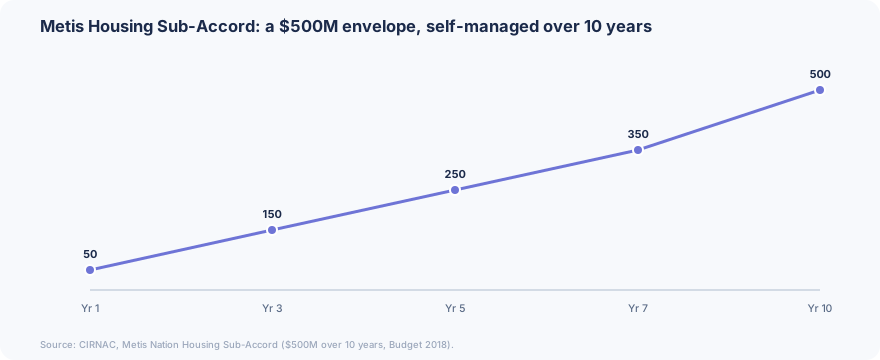
This is not abstract. The Metis Nation Housing Sub-Accord committed $500 million over ten years as the first federal housing funding delivered directly to Metis citizens - and the same agreement that handed over the money built in financial reporting, performance measurement, and evaluation as conditions of it. Self-managed funds come with a self-managed record. A government that can produce, on request, the chain from a dollar to a home it repaired is in a position of strength - with its funders, its citizens, and its own next budget. A government that has to reconstruct that chain from scattered files every time is spending its capacity on archaeology instead of housing.
How XNM helps
XNM helps Metis governments and development corporations hold the housing record in one place they own and control - applications, eligibility, contracts, inspections, repair histories, and the reporting that ties each dollar to a unit, kept current and audit-ready. Where it helps, XNM-Vision turns the accountability conditions attached to funding from a year-end scramble into a byproduct of doing the work, and gives leadership a portfolio view of the whole program. The data stays the government's own - which is the point. Self-determination over housing means self-determination over its record, and the tool should reinforce that, not quietly relocate the files somewhere else. And it stands up in days, not the long months a records project usually takes.
Practical takeaways
Treat the record as part of self-government. Owning the dollars means owning their account; build the record as deliberately as you build the homes.
Make reporting a byproduct, not a project. If the funding requires financial reporting and evaluation, capture it as the work happens - not in a year-end reconstruction.
Keep the data sovereign. The housing record should live in a system the government controls, so self-determination extends to the evidence itself.
Build memory that survives turnover. Staff and leadership change; the history of every unit built and repaired should not depend on who still works there.
Let the record argue for the next envelope. A clean, provable track record is the strongest case a government can make for a larger commitment.
FAQ
Isn't strong record-keeping just another reporting burden imposed from outside?
It can feel that way when the template is someone else's. But the shift here is that the record becomes the government's own - kept on its terms, serving its decisions first and the funder's report second. The burden is in scattered files and last-minute reconstruction, not in holding a clean record you control.
We're a small team. Is this realistic without a big back office?
That is exactly the case for one system instead of many spreadsheets. A small team cannot afford to lose time reassembling history; capturing the record once, as the work happens, is what lets a lean team govern a growing program without adding headcount to chase paper.
The bottom line
Self-government over housing is not only about who decides; it is about who can prove what was done. As Metis governments take direct control of their housing dollars, the record becomes both the evidence of good stewardship and the foundation for the next, larger commitment. Authority and accountability are the same coin - and a government that holds its own record holds both sides of it.