The Record Behind the Rebuild: Why a Hospital's Capital Project Runs on Its File

A hospital redevelopment is one of the most complex capital projects any public body will ever run. It stretches across years, often past a billion dollars, and answers at every step to a hospital board, a provincial ministry, clinical leadership, and the public that will one day be treated inside it. The building is the visible output. What actually carries the project - what keeps it on budget, on schedule, and defensible when the auditor and the board ask - is the record beneath it: the business case and funding approvals, the construction contract, equipment procurement, change orders, inspection and commissioning sign-offs, and the governance decisions that authorized each stage. A build this large does not fail on concrete. It fails on the file.
Health authorities and hospital boards sit at the intersection of clinical duty and capital stewardship, and the capital side is unforgiving. A modern hospital project layers a public-private construction contract on top of thousands of pieces of medical equipment, each with its own procurement, warranty, and commissioning trail, all of it moving while the existing hospital keeps treating patients. When the record for a project of this scale is spread across a project-management office, the constructor's system, a procurement team's spreadsheets, and the minutes of a dozen committees, the board carries a quiet risk: the decisions may all be sound, but the ability to show - to a ministry, an auditor general, or a public inquiry - exactly what was approved, what it cost, and why, is not guaranteed. In public health infrastructure, that ability is not optional.
Recent context
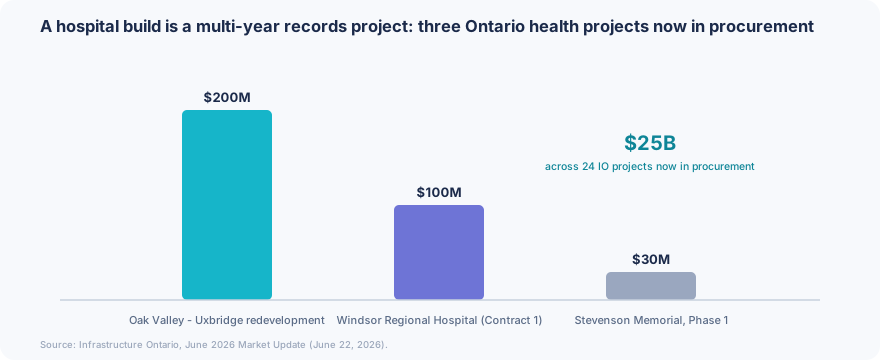
The scale of the wave is now visible. Infrastructure Ontario's June 2026 Market Update listed 24 projects in pre-procurement and active procurement with a combined design-and-construction value of more than $25 billion, among them hospital redevelopments including Oak Valley Health's Uxbridge project (about $200 million) and a $100-million contract at Windsor Regional Hospital. That pipeline sits inside a broader provincial commitment of roughly $64 billion to build and modernize more than 50 hospitals. Every one of those projects is, underneath the architecture, a years-long records project - and the ones that stay on budget are the ones whose file never falls behind the build.
A hospital build is a governance record, not just a construction site
It is tempting to treat the documentation of a hospital project as something the constructor handles. But the accountable record belongs to the health authority and its board, because they are the ones who answer for the public dollars. Every funding milestone released against a ministry agreement, every change order that moves the budget, every piece of equipment accepted into service, and every commissioning sign-off that lets a ward open is a decision the board must be able to evidence years later. Public capital projects of this size attract exactly that scrutiny - auditors general routinely examine hospital builds for cost, procurement fairness, and value for money. A file assembled after a request is the weakest possible answer; a complete, current record where approvals, costs, and decisions are tied together is the strongest. And because the existing hospital keeps operating throughout, the record also has to hold the operational thread - the phasing, the infection-control measures, the temporary works - that a purely construction-focused system would never capture.
How XNM helps
XNM helps health authorities and hospital boards pull the capital-project record into one auditable command centre - the business case and funding approvals, the construction contract and its change orders, equipment procurement and warranties, inspection and commissioning sign-offs, and the board and committee decisions behind each stage, organized by project and kept current. Where it helps, the XNM-Vision platform gives a board and a capital-projects team one line of sight across the whole build at once, so a funding milestone, a change order, or an equipment acceptance is backed by the file the moment it is questioned, and a ministry or auditor-general request meets a complete, time-stamped record rather than a reconstruction. The aim is not another system for the constructor; it is the owner's own governed record of what was approved, spent, and delivered - stood up in days rather than the many months a records overhaul usually takes, so the visibility is in place for the build in front of the board, not the post-mortem.
Practical takeaways
Own the record; do not rent it from the constructor. The constructor's system manages their work; the board answers for the public dollars and needs its own complete, independent file to prove its position.
Tie every funding milestone to its evidence. Ministry agreements release money against milestones; keep the approval, the cost, and the proof of completion in one place so the draw is never in doubt.
Govern change orders as decisions, not paperwork. A change order moves a public budget; capture what was approved, by whom, and why, in the same record as the contract it amends.
Carry the commissioning and equipment trail. A ward opens on a chain of acceptances and warranties; that trail is a patient-safety record as much as a capital one, and it has to survive.
Assume an auditor general will look. Hospital builds of this scale attract review as a matter of course; keep the file inspection-ready so scrutiny meets an answer, not a scramble.
FAQ
Our project is delivered as a public-private partnership. Doesn't the private partner hold the record?
The partner holds the record for delivering its scope, and it is theirs. The health authority remains accountable to the ministry and the public for the whole project, and that accountability needs the owner's own file: the funding approvals, the payments and change orders, the equipment and commissioning acceptances, and the board decisions. A P3 structure moves construction risk; it does not move the board's duty to be able to show what it approved and why.
We have a project-management office tracking everything. Isn't that enough?
A PMO tracks progress; the question is whether the governed record - approvals, costs, change orders, and commissioning tied together and auditable - is captured as the project moves, or reconstructed when someone asks. The value is a record that is defensible in real time, so the board can answer a ministry or an auditor from a single current picture rather than assembling one under deadline.