Fast-Tracked Still Needs the File: Why a Mine's Permit Chain Is Its Record

A mine is approved on paper long before it is built in rock. The permit chain - environmental assessment, Indigenous consultation records, water and tailings authorizations, provincial and federal permits, and the conditions attached to each - is the spine of the whole project, and every stage depends on the record produced by the one before it. Canada is now building a fast lane for major mining projects, and it is tempting to read that as less process. It is the opposite. A faster approval path does not lighten the documentary burden; it concentrates it at the front, because moving quickly is only possible when the environmental, consultation, and permitting record is already complete, current, and defensible. The fast lane does not reward the project with the fewest documents. It rewards the one whose file is ready.
Mining companies run on a permitting and compliance record that has to satisfy several masters at once - federal and provincial regulators, Indigenous nations, financiers, and the company's own board. The record threads across the whole life of a project: baseline environmental data, the impact-assessment file, consultation and accommodation agreements, permit applications and their conditions, monitoring and reporting obligations, and the audit trail that proves each condition was met. When that record is scattered across consultants' servers, a regulatory-affairs team's inbox, and the memories of people who may move on before a mine reaches production, the company carries a real exposure: a single gap - an undocumented consultation step, a monitoring report that cannot be produced, a permit condition whose evidence is missing - can stall an approval or reopen one, no matter how strong the project is on the merits.
Recent context
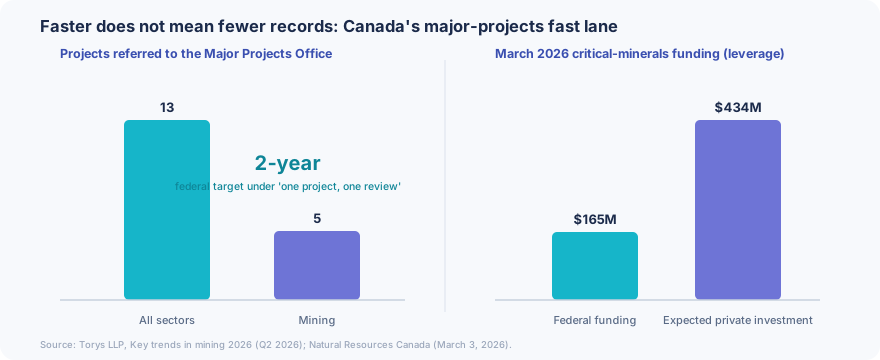
The fast lane is real, and it raises the bar on the file. As Torys noted in its 2026 review of mining trends, Ottawa's new Major Projects Office - built on a 'one project, one review' promise with a two-year federal approval target - has had 13 projects referred to it, five of them mines, while 21 mines and minerals projects sit in federal impact assessment. In parallel, a March 2026 federal package put up $165 million for critical-minerals projects, expected to unlock some $434 million in private investment, and British Columbia, Ontario, and Quebec have each moved to streamline their own approvals. Faster timelines and more money both raise the same demand: a project can only move at speed if its permitting and consultation record can keep up.
Speed is a records test, not a paperwork holiday
It is easy to hear 'streamlined approvals' as a lighter documentary load. For the proponent, it is the reverse. A two-year federal clock and a single coordinated review mean the regulator, the affected nations, and the financiers are all working from the same file at the same time - and any hole in that file becomes a bottleneck for everyone at once. The consultation record has to show not just that engagement happened but what was said and how it was accommodated; the environmental baseline has to be current and traceable; every permit condition needs its evidence attached and retrievable. None of that is optional under a faster regime - it is the precondition for using it. And the record does double duty long after approval: permit conditions carry monitoring and reporting obligations for the life of the mine, and the ability to prove compliance on demand is what keeps a licence in good standing and a social licence intact. The companies that will actually benefit from the fast lane are the ones whose record was built to move at that speed.
How XNM helps
XNM helps mining companies pull the permitting and compliance record into one auditable command centre - baseline data, the impact-assessment file, consultation and accommodation records, permit applications and their conditions, and the monitoring and reporting that each condition demands, organized by project and kept current. Where it helps, the XNM-Vision platform gives a regulatory-affairs team and its board one line of sight across the whole permit chain, so a coordinated review draws from a complete, current file rather than a scramble, a consultation step or a monitoring obligation is evidenced the moment it is questioned, and a regulator or a nation's request meets a defensible record rather than a reconstruction. The aim is not another drive to search; it is the single governed record that the approval, the conditions, and the mine's whole compliance life all depend on - and because it stands up in days rather than the months a records overhaul usually takes, the file is ready for the fast lane, not lagging behind it.
Practical takeaways
Treat the permit chain as one connected record. Each stage depends on the file from the last; a gap early on surfaces as a bottleneck exactly when a fast-tracked review cannot absorb it.
Make the consultation record show substance, not just contact. What was raised, and how it was accommodated, is what a regulator and a nation both ask; keep that evidence complete and retrievable, not scattered in inboxes.
Keep the environmental baseline current and traceable. A stale or unsourced baseline is a reopened question; the record has to show where each data point came from and when.
Attach the evidence to every permit condition. Conditions carry obligations for the life of the mine; keep each condition's proof of compliance with the condition itself, ready to produce on demand.
Build the record to move at the new speed. A two-year clock rewards the file that is already assembled; the time to get the record in order is before the fast lane, not during it.
FAQ
Our environmental consultants hold most of this. Isn't that our record?
Consultants produce much of the underlying data, but the accountable record belongs to the proponent - the company that holds the permits and answers for the conditions. When a coordinated review, a nation, or a regulator asks for the consultation history or a monitoring obligation, you need your own complete, independent file, not a request routed through several firms. Relying on a consultant's server for evidence you are accountable for is exactly the exposure a faster, higher-stakes process makes costly.
Won't a streamlined process mean less documentation overall?
It means less duplicated process, not less evidence. A single coordinated review removes overlapping steps, but the substance - the baseline, the consultation record, the permit conditions and their proof - is exactly what the review still turns on, now on a tighter clock. The documentary demand does not fall; it simply has to be met faster, which is why the ready file wins.