The Org Chart Doesn't Run Your Project. The Record Does.

Point to the org chart and you can name who is in charge of anything. The boxes are clear, the lines are clean, the titles are impressive. Now fast-forward a year, to the moment a decision gets challenged - a change that cost money, an approval someone says never happened, a direction that turned out wrong. Point to the org chart again. It tells you who was supposed to decide. It cannot tell you who actually did, what they decided, or when. In that moment, the org chart is decoration. The record is the only thing standing.
We confuse two different things: the structure of authority and the evidence of it. The org chart describes the structure - the roles, the reporting lines, the theoretical right to decide. But authority on a real project is not exercised by a box on a chart; it is exercised by a person, on a date, making a specific call that other people then act on. If that call was never written down, the authority that produced it effectively never existed - because a year later, nobody can prove it did. By the end of this, you'll see why the documented decision, not the title, is where authority actually lives.
A title says who may decide. A record says who did.
Consider how decisions actually get made on a busy project. A question comes up in a corridor. A senior person says 'yes, go ahead.' Work proceeds. Everyone believes the decision was made by someone with the authority to make it - and they're probably right. But 'probably right' is not a defence. When the consequence of that yes shows up later, the question is never 'was this person senior enough?' The question is 'can you show me the decision?' A title answers the first question. Only a record answers the second.
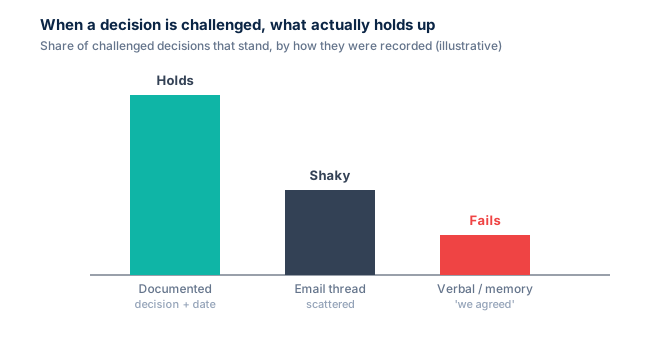
This is why projects with flawless org charts still descend into disputes. The structure was never the problem. The problem is that the structure produced decisions faster than anyone captured them, so the project accumulated a long trail of consequential calls that exist only in memory. Memory is not evidence. When two people remember the same conversation differently - and under pressure, they always do - the org chart cannot break the tie. Only the record can.
Governance is the discipline of recording decisions
Good project governance is often described as having the right people in the right roles. That's necessary but not sufficient. The deeper discipline is making sure that every decision those people make leaves a trace: who decided, what they decided, when, and on what basis. Not a bureaucratic trace - a usable one. The point is not to slow decisions down; it's to make sure a fast decision today is still a defensible decision tomorrow. A project where authority is exercised constantly but recorded rarely is a project running on borrowed time, and the loan comes due the first time someone disagrees with an outcome. This is the gap XNM-VISION is built to close: a single place where the decisions that govern a project are captured and findable, so authority leaves a record instead of just an impression.
This week, take one consequential decision your project made recently and ask: if someone challenged it in a year, what would you point to? If the honest answer is 'the conversation' or 'everyone knows,' the decision is undefended - not because the wrong person made it, but because the right person never recorded it. Promote the people you trust, draw the org chart however you like, but understand what it is: a map of who may speak. The record is the only proof of what was said. Run your project on the record, and let the org chart be what it actually is - a diagram, not a defence.
Authority, approvals, and accountability all come down to the same thing - a decision someone can find later - more on why the record, not the title, runs the project trace how documented decisions hold when memory doesn't.