Field Notes: Provincial Crown Agencies and the Delivery Gap

Walk into a provincial Crown agency this year and you will hear a strange contradiction. The capital plan is the largest anyone can remember. The funding is committed. The need is obvious, hospitals, transit, schools, grids. And yet, quietly, a great deal of it is not getting built on schedule. The money is not the problem. The design is not the problem. The problem is delivery, and delivery has become a records problem in disguise.
This is the delivery gap: the widening distance between what has been approved and what actually gets completed. For decades the assumption was that if you could secure the funding, the building would follow. That assumption is breaking, and the agencies that understand why will deliver while the others explain. By the end of this you'll see why the constraint moved, and where it went.
When money stops being the bottleneck
For a long time, the scarce resource in public infrastructure was capital. Get the budget approved and the rest was execution. But when every agency is funded at once, capital stops being scarce and something else becomes the limiting factor: the capacity to actually move a project through its hundreds of approvals, sign-offs, permits, and reviews without losing momentum.
At megaproject scale, a project does not usually fail in a single dramatic moment. It fails in a thousand small stalls, an approval waiting on a document nobody can locate, a permit condition tracked in one person's inbox, a review that restarts because the version everyone was working from turned out to be stale. Each delay is minor. Together, across a portfolio of dozens of concurrent projects, they are the delivery gap.
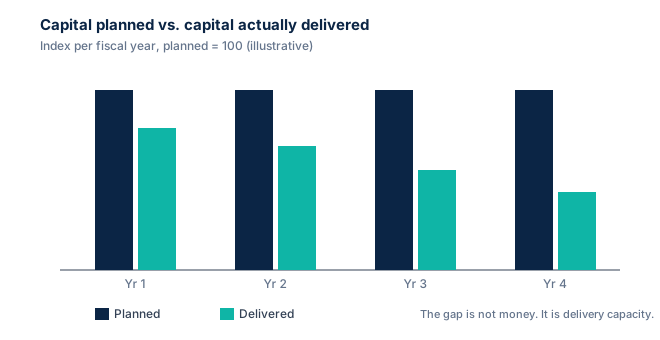
The chart shows the pattern agencies are living: planned capital holds flat at the top while delivered capital drifts further below it each year. The space between the bars is not unspent good intentions. It is projects caught in the machinery of approvals and records that was never built to move at this volume.
Delivery runs on findable records
The agencies closing the gap are not the ones with more money; they are the ones that have made their projects move. And movement, at this scale, depends on a boring foundation: can the right person find the right document, in its current version, at the moment a decision is waiting on it? When the answer is yes, approvals flow and projects keep their momentum. When it is no, the project joins the gap.
That is why records maturity has quietly become a delivery strategy. A Crown agency that can prove readiness, produce the current document on demand, and show a clean approval trail moves projects through the pipeline faster than one that cannot, even with identical budgets. The capital plan is a delivery test, and the test is administered one document at a time.
What to watch for
If you work inside or alongside a Crown agency, the warning sign is not a budget shortfall; it is a calendar full of approvals that keep slipping for reasons no one can quite name. That is the delivery gap announcing itself. The agencies that treat findable, current, complete records as core delivery infrastructure, rather than back-office housekeeping, are the ones that will turn the largest capital plan in history into something you can actually point at.
The delivery gap is the same findability problem that stalls a single project, scaled to a portfolio - see how other sectors fight the same battle in our field notes, from health authorities to engineering firms.