One Chart: How Version Confusion Spreads

Version confusion does not arrive as a catastrophe. It arrives as a convenience. Someone downloads a file to work on offline. It is the current version that day. They make their changes, save a copy, and email it to two colleagues who need it. Nothing about that is careless. And it is exactly how a single stale file quietly becomes the foundation under a dozen people's work.
The reason version confusion is so dangerous is that it spreads, and it spreads faster the longer it goes unnoticed. One chart tells the whole story better than a page of warnings could. By the end you'll see why the moment to catch it is week one, not week three.
One file, copied five times
Picture a single document that fell one revision behind, the budget shifted, the scope changed, a date moved, but one copy never got the update. On day zero, exactly one person holds the stale version. They are not worried; as far as they know, they have the file. Then the ordinary mechanics of teamwork take over. They share it. The people they share it with save their own copies and share those. Each handoff feels like the safe, responsible choice, and each one adds another person building on a foundation that is quietly wrong.
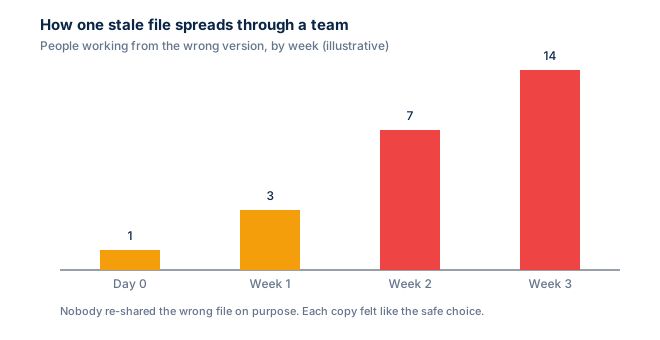
That curve is the entire argument. It does not climb in a straight line; it accelerates. One becomes three, three becomes seven, seven becomes fourteen, because each copy looks exactly as trustworthy as the original. There is no visible mark on a stale file that says do not trust me. It carries the same name, the same format, the same confident appearance as the current one. The spread is invisible precisely because nothing about any single copy looks wrong.
Why it accelerates
The acceleration comes from a simple, brutal fact: a copy carries no memory of whether its source was current. Once the stale version is loose, every downstream person who shares it does so in good faith, multiplying it again. By the time someone notices the numbers don't reconcile, the wrong version has out-bred the right one, and untangling which work was built on which file becomes its own project, often more expensive than the original error.
Catch it where the curve is flat
The practical takeaway sits on the left side of the chart, where the line is still low and flat. Version confusion is cheap to fix on day zero, when one person holds the wrong file, and ruinously expensive by week three, when fourteen do. The defense is not vigilance, which does not scale, but structure: a single controlled copy that everyone references in place, so that current is a property of the system rather than a guess about which download was latest.
Today, look at the most important number on your project, a budget, a date, a quantity, and ask how many copies of it exist and whether you could prove they all agree. If you cannot, you are somewhere on this curve already. The only question is which week.
This curve is what a single source of truth is designed to flatten - more on getting every copy to agree, across email and shared drives, and why the fix is structural, not personal.