
The Fund Was Renamed. The Filing Cabinet Was Not.

Most of the money Canadian communities count on for local infrastructure does not arrive with a ribbon on it. It arrives as a transfer — indexed, predictable, paid up front — and for two decades it has carried one name or another: first the Gas Tax Fund, then the Canada Community-Building Fund. This fiscal year it changed names again. The Canada Community-Building Fund has been rebranded as the Community stream of the Build Communities Strong Fund, the federal government's new $51-billion, ten-year infrastructure package. For the administrator in a small office who has managed this transfer for years, the temptation is to treat the change as cosmetic: the cheque still comes, and the project categories look familiar. But a renamed fund means renewed agreements, a fresh ten-year horizon, and a new generation of reporting that will be rolled up nationally for a decade. The question that decides whether that decade is comfortable or painful is not what the fund is called. It is who keeps the record.
Recent context
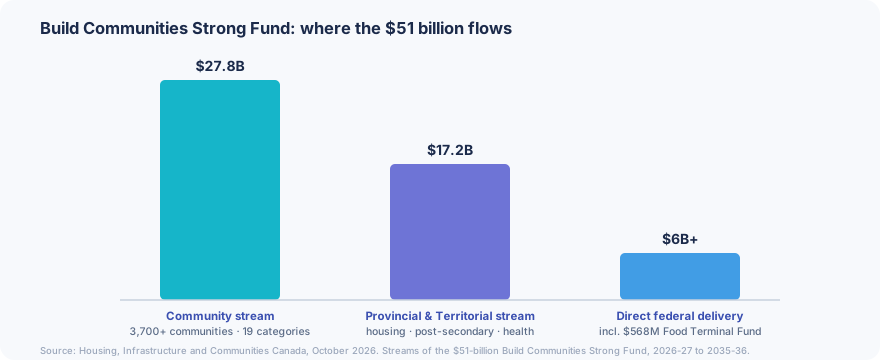
The figures are public. According to Housing, Infrastructure and Communities Canada, the Build Communities Strong Fund provides $51 billion over ten years, starting in 2026–27, and $3 billion per year ongoing, delivered through three streams. The Community stream — the renamed Canada Community-Building Fund — carries $27.8 billion over ten years and delivers more than $2.5 billion every year to over 3,700 communities, which choose their own investments across 19 project categories, from local roads, drinking water and wastewater to broadband, culture and climate resilience. A Provincial and Territorial stream provides $17.2 billion over ten years for projects related to housing, post-secondary education and health. The balance — more than $6 billion — is delivered directly through federal programs such as the $568-million Food Terminal Fund, whose first intake runs from October 14 to December 11, 2026. The Community stream's mechanics are unchanged in outline: funding flows up front to provinces and territories — or to municipal associations in Ontario and British Columbia — which flow it to communities; communities select the projects; and what the money did is reported back up, year after year, into national annual reports.
Flexible money is the hardest money to document
That sounds backwards, so it is worth saying carefully. A conventional project grant builds your file for you. You apply, so there is an application. A reviewer approves, so there is an approval letter. You claim against milestones, so there are claims, and the program's own rules tell you what to keep. The paper trail may be burdensome, but it is at least defined by someone else. The Community stream is the opposite kind of money. It arrives before any project is chosen. The community itself decides what it is for — which of the 19 categories, which asset, which year — and that local decision, not a federal reviewer's, is the first document in the file.
Which means the record of this fund is something every community constructs for itself: the council resolution that directed the funds to the lift station rather than the arena; the category election behind it; the procurement that followed; the change orders; the inspection that closed the project out. None of that paper is generated by the program. All of it is what the annual reporting ultimately stands on. When the roll-up asks what $2.5 billion a year accomplished, the answer is assembled from thousands of local files — and a flexible fund will not notice that yours is incomplete until the year someone asks.
Ten years is longer than your staff list
The new stream is committed through the mid-2030s. Almost no one administering it today will be in the same chair at the end of it. In small communities the fund is often managed by an administrator who also runs payroll, the cemetery and the dog bylaw; in larger ones it moves between a finance department, public works and whoever is acting that season. A question asked in 2033 about a culvert built in 2027 will be answered by someone who was not there — from whatever the file says, or does not. The organizations that answer such questions easily are not the ones with the best memories. They are the ones whose records were designed to be read by a stranger: dated, filed against the project they belong to, and kept in a system that survives the person who created them.
What the first year should actually produce
Year one of a ten-year fund sets the pattern every later year inherits — which makes 2026–27 the year to set up the record system, not just the year to pick the first projects. The spine is modest. One register that ties every allocation to its category election and the council resolution behind it. One file per project that holds the approval, the contract, the change orders and the evidence of completion, in one place rather than five inboxes. One location where outcomes land when the project closes, so the annual report is an export rather than an archaeology dig. The software matters less than the discipline, but the discipline has to be installed at the start: a fund this flexible will never impose it for you.
The fund has a new name and a long runway, and for most communities it remains the most dependable infrastructure money there is. That is exactly why its records deserve better than habit. When the first reports of the Build Communities Strong era are assembled, the raw material will be the local files of more than 3,700 communities. The ones that stay in control of their own story — and of the questions that arrive years later — will be the ones that can produce the document instead of the recollection. The name on the fund changed this year. The filing cabinet is still yours.