The Backlog Beneath the Campus: Why University Renewal Starts With the Record
A university campus is one of the most complex real-estate portfolios in the country: research labs, residences, lecture halls, heritage buildings, and the hidden network of boilers, roofs, elevators, and electrical systems that keep them running. Much of it was built in the postwar and early-2000s booms, and much of it is now aging out at once. Renewal money is finally arriving after years of scarcity. The question every VP of operations and CFO faces is not whether the buildings need work - they plainly do - but which work comes first, and whether the answer will hold up when a board or an auditor asks why.
Deferred maintenance is, at bottom, a records discipline. Doing it well means knowing, for every building and system, its condition, its remaining life, the cost to renew it, and the consequence if it fails - a flooded lab, a closed residence, a research grant at risk. That knowledge lives in condition assessments, capital plans, work-order histories, warranty and contract files, and the funding agreements behind each project. When those records are scattered across a facilities department, external assessors, and finance systems that do not reconcile, the renewal list becomes a negotiation between deans rather than a decision grounded in evidence - and the buildings that get attention are the ones with the loudest advocates, not the highest risk.
Recent context
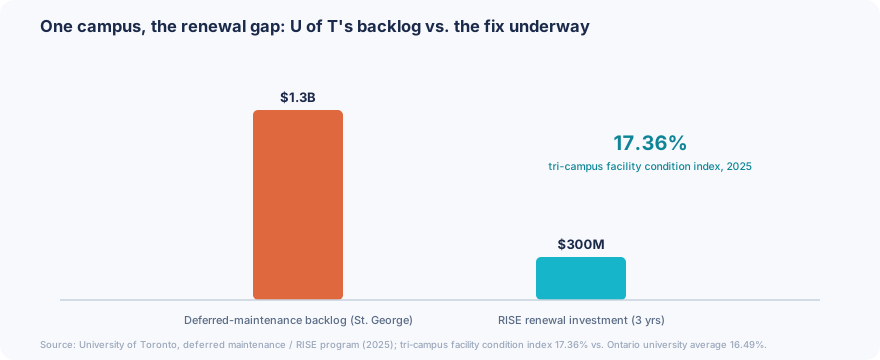
The gap is large and measured. The University of Toronto reports a deferred-maintenance backlog of roughly $1.3 billion on its St. George campus alone, and in 2025 launched its RISE program - a $300-million, three-year investment covering more than 300 projects across 68 buildings, from elevators and HVAC to roofs and fire protection. Its tri-campus facility condition index stood at 17.36% in 2025, slightly above the Ontario university average of 16.49% - a reminder that even a well-resourced institution is renewing against a backlog that dwarfs any single year's budget.
A renewal list is only as good as the record beneath it
New money is welcome, but it does not by itself decide which of hundreds of building systems to touch first. That decision is only as good as the condition record it is built on. An institution that can rank its assets by condition, remaining life, and consequence spends its renewal dollars where they buy the most risk reduction - the roof one winter from failure, the electrical system a fault away from shutting a research wing. One working from stale assessments and disconnected spreadsheets spends the same money later and less well, and cannot easily show a board or a funder why this project and not that one. The discipline also protects the institution when the money is public: a grant-funded renewal is audited, and the case has to be defensible long after the ribbon is cut.
How XNM helps
XNM helps universities and colleges pull the facilities and capital-renewal record into one auditable command centre - condition assessments, capital plans, work-order and warranty histories, contracts and change orders, and the board approvals and funding agreements behind each project, connected and kept current. Where it helps, the XNM-Vision platform gives a VP of operations, a CFO, or a board one line of sight across the whole campus, so the renewal list is built on evidence rather than advocacy, and a funder's or auditor's question is answered from a record that already exists. Because it stands up in days rather than the months a records overhaul usually takes, the visibility arrives in time to shape this year's capital plan, not next year's.
Practical takeaways
Treat the condition record as core infrastructure. A renewal plan is only as good as the assessment behind it; a stale record quietly mis-prioritizes every dollar and every risk.
Rank by consequence, not by advocacy. The point of condition data is to put the highest-risk failure first - keep it where the capital plan is built, not in a dean's inbox.
Make grant-funded renewals audit-ready by default. Public renewal money is audited; keep the record in a state where the answer to 'why this project' is already there.
Give the board one campus view. A board overseeing thousands of assets needs a single, current picture - not a binder per faculty refreshed once a year.
Keep the history when the assessor changes. Condition and work-order knowledge should stay with the institution, not leave with a consulting contract.
FAQ
We commission a facility condition assessment on a cycle. Isn't that the record?
An assessment is a snapshot; the record is the living system it feeds. A point-in-time report drifts out of date as systems age and projects close, and it sits apart from the work orders and capital decisions that should update it. The value is a record where condition, work history, and renewal decisions move together - so the plan reflects the campus as it is now, not as it was at the last survey.
Isn't the real problem just decades of underfunding?
Underfunding is real, but visibility is the part the institution controls. New renewal money spent against a thin record buys less risk reduction than the same money spent against a clear one. Getting the record right is how each dollar reaches the building system whose failure would cost the most - in dollars, in safety, and in lost research or teaching time.
The bottom line
The backlog beneath the campus is a governance story before it is a construction one. As renewal money returns after years of scarcity, the institutions that turn it into resilient campuses will be the ones that can see their own buildings - every system, its condition, and the cost of its failure - in one current, defensible record. You cannot renew what you cannot see, and on a campus that ages all at once, seeing clearly is the whole game.