Building Homes That Have to Last: Why Community Housing Runs on the Record
A non-profit cuts the ribbon on a new affordable-housing building, and the moment feels like the finish line. It is closer to the starting line. The capital that built it came with conditions - affordability terms, reporting obligations, and covenants that can run for decades - and the building itself now needs to be operated, maintained, and accounted for across a lifespan measured in generations. For a community housing provider, the grant is the easy part. The record that has to outlive it is the hard one, and it is the record, not the ribbon, that determines whether the next project gets funded.
A non-profit housing provider carries a documentation load most people never see: capital funding agreements and their affordability covenants, construction and warranty files, tenant and rent records, annual compliance and financial reports, and the board decisions behind every project - across a portfolio that may span many buildings and several funders, each with its own rules. When those records are scattered across program staff, property managers, external bookkeepers, and a founder's filing cabinet, the organization is exposed exactly where a mission-driven group can least afford it: a missed compliance report, an affordability covenant no one can locate, a funder's audit that turns into a scramble. In community housing, the record is not overhead - it is the license to keep operating.
Recent context
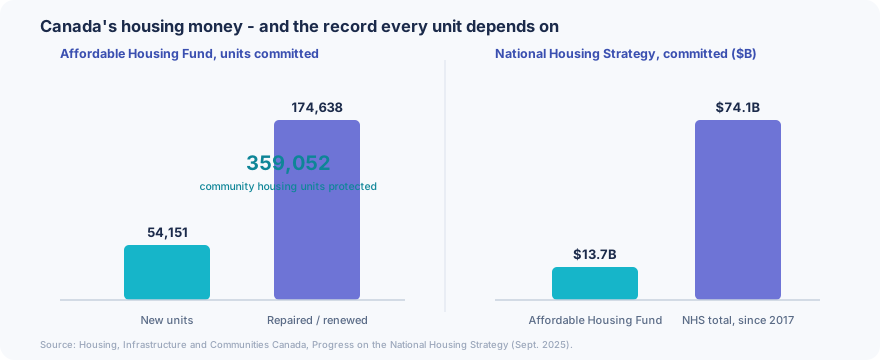
The scale of public support is large and growing. The federal government's September 2025 National Housing Strategy progress report shows $74.1 billion committed since 2017, including $13.7 billion through the Affordable Housing Fund toward 54,151 new units and 174,638 repaired ones, with 359,052 community housing units protected. Repairs now far outnumber new builds - a reminder that much of the sector's work is stewarding an aging stock over decades. Each of those units carries a compliance and reporting obligation that follows it long after construction ends.
The building is funded once; the record is forever
Capital funding is a moment; stewardship is a marathon. An affordability covenant may bind a building for twenty, thirty, or forty years, and every year of it generates reporting a funder can ask to see. A provider that keeps a clean, current record - agreements, covenants, compliance filings, maintenance and financials, tied to each building - answers those requests from evidence that already exists, renews funding smoothly, and passes audits without drama. One that reconstructs its file each time pays in staff time it does not have, in missed deadlines, and occasionally in a finding that puts future funding at risk. The reputational stakes are acute for mission-driven organizations, where a single compliance failure can shadow every future application. The record is how a small non-profit proves, again and again, that it is a safe pair of hands for public money.
How XNM helps
XNM helps non-profit and community housing providers bring the whole capital and stewardship record into one auditable command centre - funding agreements and affordability covenants, construction and warranty files, compliance and financial reports, maintenance histories, and the board decisions behind each project, organized by building and funder and kept current. Where it helps, the XNM-Vision platform gives an executive director or a board one line of sight across every property and every funder obligation at once, so a compliance report, an audit, or a new grant application is answered from a record that already exists - and the institutional memory stays with the organization, not a departing staffer. Because it stands up in days rather than the months a records overhaul usually takes, the readiness is there for the next reporting cycle and the next application.
Practical takeaways
Treat the record as your license to operate. Public housing money comes with covenants and reporting that run for decades; a clean, current file is what keeps the funding and the doors open.
Track affordability covenants where you can find them. A commitment you cannot locate is a compliance risk waiting to surface - keep every covenant tied to the building it binds.
File by building and by funder, not by inbox. A portfolio spanning several funders needs one record that answers each one's rules, not a scramble per audit.
Make every application draw on the last. The compliance record that satisfied one funder is the evidence base that speeds your next grant - build it once, reuse it.
Keep the memory when a founder or staffer leaves. In lean organizations the whole history can live in one person; the record should stay with the mission, not walk out the door.
FAQ
We report to each funder on their schedule. Isn't that enough?
Reporting on schedule is necessary, but it is not the same as a record you can stand behind. When each report is assembled from scattered sources, an off-cycle audit or a funder's follow-up question becomes a crisis, and the answers may not reconcile across funders. The value is one living record every report is drawn from - so compliance is a routine, not an emergency.
We are a small organization. Is this level of record-keeping realistic?
It is most realistic - and most necessary - when you are small, because there is no back office to absorb a scramble and no margin for a lost grant. A single current record is how a lean non-profit meets decades of obligations without a decades-sized administrative team; the discipline is what lets the mission, not the paperwork, get the staff's attention.
The bottom line
Community housing is a promise that has to be kept for a very long time, and public capital only accelerates the obligation. The non-profits that keep building - and keep getting funded - will be the ones whose record can prove, at any moment, that every home is accounted for and every covenant honoured. The ribbon marks the building's start; the record is what carries it through the decades that matter.