Signed for a Generation: Why an Indigenous JV Runs on Its Commitment Register
A benefit agreement between a First Nation and an industrial partner - an LNG facility, a mine, a hydro project - is often celebrated as a signing. It should be understood as a beginning. The agreement commits the partner to a long list of obligations: employment and training targets, local procurement, revenue and payment schedules, environmental monitoring, cultural protections, and infrastructure. Those commitments do not expire at the ceremony; they run for the life of the project, which can mean thirty or forty years. And a commitment that is not tracked is a commitment that quietly does not happen. For the community, the agreement is only as strong as the record that holds it to account.
An Indigenous joint venture or development corporation overseeing a major-project agreement carries a governance load few organizations face: dozens of distinct commitments, each with its own milestone, metric, and responsible party, spread across a multi-decade timeline and multiple corporate partners whose own staff turn over. Payment schedules tied to production, hiring targets measured year over year, environmental conditions monitored season by season, and the founding agreements and amendments behind them all. When that lives in a binder, a lawyer's file, and the memory of the leaders who negotiated it, the community's leverage erodes with every retirement and every change of partner personnel - precisely when a long agreement most needs continuity.
Recent context
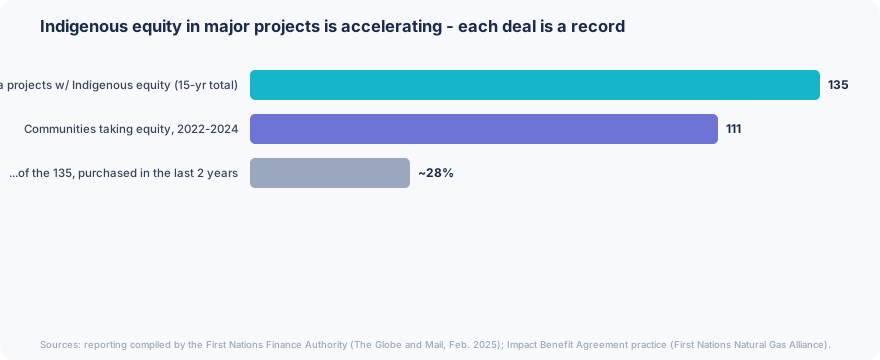
Ownership is becoming the norm. As practitioners describe benefit-agreement design, these agreements are meant to span the full project lifecycle - from pre-construction through operation to decommissioning - with implementation committees that track progress, evaluate metrics, and provide recourse when a party falls short. This matters more each year: reporting compiled by the First Nations Finance Authority notes that at least 111 Indigenous communities took or announced an equity interest in a major infrastructure project between early 2022 and April 2024, with roughly 28% of the last fifteen years' worth of such deals occurring in just the final two. The commitments are multiplying, and so is the record that governs them.
The commitment register is the agreement's teeth
A signed agreement is a promise; a commitment register is how the promise is kept. The communities that get the full value of their agreements treat every obligation as a tracked, living item - what was promised, who owns it, when it is due, and the evidence it was met - so that an implementation committee meeting, a payment reconciliation, or a dispute is settled from a record rather than a memory. This is not adversarial; it is the basis of a durable partnership. A company generally wants to meet its obligations, but over decades and staff changes, things get missed on both sides. A shared, current record of commitments protects the relationship as much as the community - and it turns the agreement from a document that gathers dust into a management system that delivers the benefits it promised, year after year.
How XNM helps
XNM helps First Nations, their joint ventures, and development corporations turn a benefit agreement into a live commitment register in one auditable command centre - every obligation, milestone, payment, hiring and procurement target, and environmental and cultural condition, tied to the agreement clause it comes from and tracked with the evidence it was met. Where it helps, the XNM-Vision platform gives Indigenous leadership one line of sight across every commitment and every partner at once, so an implementation committee, an audit, or a renewal negotiation is grounded in a record the community controls - not the partner's. Because it stands up in days rather than the months a records project usually takes, the tracking is in place for the next reporting period, and the institutional memory stays with the Nation across the decades the agreement runs.
Practical takeaways
Turn the agreement into a tracked register. A commitment you are not tracking is one that quietly does not happen; every obligation needs an owner, a due date, and evidence.
Tie each commitment to its clause. When a question arises, you want the obligation and the language that created it in the same place - not a treasure hunt through the signed document.
Hold the record under community control. Sovereignty over the record is leverage in every implementation meeting; the file should live with the Nation, not the industrial partner.
Plan for the full project life, not the signing. Obligations run for decades and staff turn over on both sides; the register is what carries continuity past any individual.
Make the evidence of compliance routine. Payments, hires, and monitoring results logged as they happen turn an audit or a dispute into a lookup, not a reconstruction.
FAQ
We have legal counsel and an implementation committee. Isn't that enough?
Counsel drafts the agreement and the committee meets on it, but neither is a living record of whether each commitment is being met day to day. The gaps open between meetings, as milestones pass and personnel change. The value is a current register the committee and counsel both work from - so every meeting starts from evidence, and nothing depends on who happens to remember.
Won't tracking every commitment strain the relationship with our partner?
It usually strengthens it. Most partners want to deliver, and disputes are far more likely to come from ambiguity than bad faith. A shared, current record of what was promised and what has been done removes the ambiguity, makes reconciliation routine, and keeps a decades-long relationship running on facts instead of competing memories.
The bottom line
As Indigenous communities move decisively from being consulted to owning a share of the projects on their land, the benefit agreement becomes one of the most important documents a Nation holds. Its value is not in the signature but in the follow-through - and follow-through is a records discipline. The communities that capture the full promise of these agreements will be the ones whose commitment register never lets a single obligation fall quietly through the cracks.