Recorded Without Note or Comment: Why Council Governance Runs on the Record
A resident asks a simple question at the counter: why did council approve that rezoning, and what did staff advise before the vote? In a well-run municipality the answer is a lookup - the minutes, the staff report, the recorded vote, all in one place. In too many, it is the start of a three-week search across the clerk's files, a department's inbox, and a report someone remembers but cannot find. The decision was legitimate; the record of it was not ready. And in local government, a decision you cannot readily show is, for practical purposes of trust and accountability, a decision you cannot fully defend.
A municipality runs on its governance record more than almost any other kind of organization, because its authority is procedural: council can only act through recorded resolutions, and those resolutions are only trustworthy if the record behind them is complete. Agendas, staff reports, minutes, recorded votes, delegated authorities, closed-session records, and the bylaws that result - multiplied across council, committees, and local boards, year after year. When that record is fragmented across a clerk's office, individual departments, and personal files, the municipality is exposed exactly where it must be strongest: in proving that a decision was made properly, on the advice of record, and in the open where the law requires.
Recent context
The obligation is explicit. Ontario's Municipal Act, as summarized in the province's councillors' guide, requires a municipality to record, without note or comment, all resolutions, decisions and other proceedings of council - whether the meeting is open or closed - and sets a strong default that meetings be public, with narrow, defined exceptions. The duty is not merely to decide; it is to keep a faithful, inspectable record of deciding. Similar transparency and records obligations apply to municipalities across the country, and they are only meaningful if the record can actually be produced on request.
A decision is only as defensible as its record
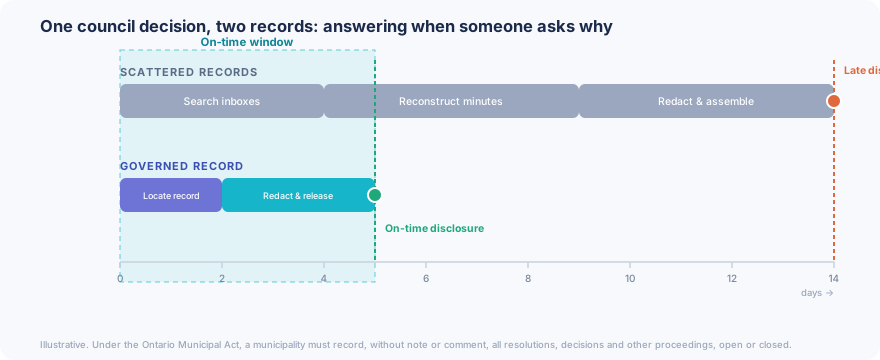
Open meetings and recorded votes exist so that residents, and the courts if it comes to that, can see how a decision was reached. But the legal duty to record is only half the job; the other half is being able to retrieve and produce that record when someone asks. A municipality with a governed record answers a councillor's question, a resident's request, or an integrity commissioner's inquiry from a single current source, in days. One with a fragmented record spends weeks reconstructing what happened, risks releasing an incomplete or inconsistent account, and erodes the very trust the transparency rules were meant to build. The stakes rise with every capital project a council oversees: as new infrastructure money flows to municipalities, the decisions authorizing that spending are exactly the ones the public - and auditors - will want to trace.
How XNM helps
XNM helps municipalities bring the whole governance record into one auditable command centre - agendas and staff reports, minutes and recorded votes, delegated authorities, closed-session records, and the bylaws and capital-project decisions that follow, organized and kept current. Where it helps, the XNM-Vision platform gives a clerk, a CAO, or council one line of sight across every decision and the evidence behind it, so a records request, an integrity inquiry, or an auditor's question is answered from a record that already exists rather than reconstructed under a statutory clock. Because it stands up in days rather than the months a records overhaul usually takes, the readiness is there for the next council meeting and the next request - not after the trust has already been spent.
Practical takeaways
Treat the governance record as the source of authority. Council acts through recorded decisions; if the record is incomplete or unfindable, the authority behind the decision is harder to defend.
Keep the decision and its evidence together. A resolution without the staff report and recorded vote beside it invites exactly the questions you cannot quickly answer.
Make retrieval as reliable as the duty to record. The law requires you to keep the record; trust requires you to produce it fast - build for both.
Tie capital decisions to their authorizations. As infrastructure money flows, the vote that approved each project is what auditors and the public will trace - keep it linked.
Preserve continuity across terms and turnover. Councils change and clerks retire; the governance record must outlast any individual to keep the municipality accountable to its own history.
FAQ
We keep official minutes as the law requires. Isn't that the record?
Minutes are the spine, but they are not the whole body. The defensibility of a decision usually rests on the staff report, the recorded vote, and the correspondence around it - and those often live apart from the minutes. When a question arises, the gap between 'we have minutes' and 'we can produce the full basis of this decision' is where the weeks disappear. The value is a record where the decision and its supporting evidence sit together.
Won't a system like this make closed-session material less secure?
A governed record makes it more secure, not less. Fragmented files are the real exposure - copies in inboxes, drafts on drives, no clear control over who can see what. A single governed record lets a municipality apply consistent access rules, keep a proper closed-session record where the law allows, and know exactly what exists and who can reach it - which is stronger protection than scattered files ever offer.
The bottom line
A municipality's legitimacy is inseparable from its record: council governs by deciding on the record, in the open, and standing behind those decisions when asked. As councils oversee a rising tide of capital spending, the ability to show why - completely, quickly, and consistently - becomes the difference between a government that holds public trust and one that spends it down. Recorded without note or comment is the law's phrase; a record you can actually produce is what makes it mean something.