Draw by Draw: Why a Developer's Capital Program Lives or Dies on Its Record

A developer's project does not advance on concrete; it advances on documents. Every construction draw the lender funds depends on a package - progress billings, statutory declarations, holdback calculations, change-order logs, and inspection sign-offs - that has to be complete, current, and reconcilable before money moves. Miss a piece and the draw stalls: the trades do not get paid, the schedule slips, and the interest keeps running on the loan regardless. For a developer or owner-operator carrying several projects at once, the record is the throttle on the entire capital program. The building the market sees is the output; the file is the machine that produced it.
Development runs on a stack of interlocking records that most people never see. Land and financing agreements, the pro forma the whole deal was underwritten against, permits and their conditions, the prime contract and every subcontract, change orders, requests for information, holdback ledgers, lien and statutory-declaration files, insurance and bonding, draw packages, and the investor and lender reporting that ties it all together. When a single project's record is scattered across a project manager's laptop, a lawyer's file, the general contractor's system, and a finance spreadsheet, the developer absorbs the cost in three places at once: draws that arrive late because the package could not be assembled in time, disputes over what was authorized when a change order is questioned, and exposure when a holdback release, a lien claim, or an investor demand lands and the supporting record is not immediately at hand.
Recent context
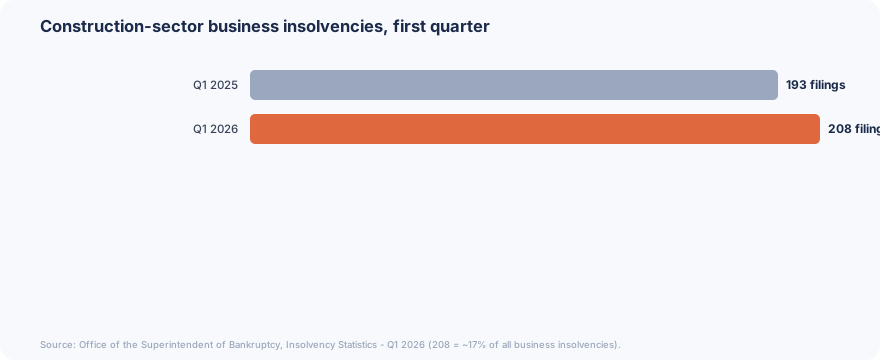
The documentary bar just rose, in a market that is tightening. Ontario's Construction Act amendments, in force January 1, 2026, make annual holdback release mandatory rather than optional and require owners to publish formal notice within days of a contract anniversary - and British Columbia's prompt-payment and adjudication regime received royal assent in November 2025. At the same time, the payment chain is under real stress: the Office of the Superintendent of Bankruptcy recorded 208 construction-sector business insolvencies in the first quarter of 2026, up 7.8% from a year earlier and roughly 17% of all business insolvencies. Tighter rules on holdback and payment, in a market with more failing counterparties, put a premium on a record that can prove exactly who is owed what, and when.
The leaks are in the holdback and the change orders
Ask any experienced developer where a capital program bleeds value, and the answer is rarely the headline construction cost. It is the holdback that was released without the paperwork to support it, the change order that was built but never formally approved, the draw that came a month late because a statutory declaration was missing, and the investor question that took three days to answer because the numbers lived in four places. None of these is a construction problem; each is a records problem wearing a hard hat. And the new holdback rules make the point sharper: mandatory annual release with formal notice periods means the calculation and its supporting file have to be right and ready on a schedule, not reconstructed when a subcontractor asks. The developers who protect their returns are the ones whose record can answer, on demand, what was approved, what was paid, what is held back, and what is owed.
How XNM helps
XNM helps developers and owner-operators pull the whole capital-program record into one auditable command centre - the pro forma, agreements, permits, contracts and change orders, holdback ledgers, statutory declarations, draw packages, and lender and investor reporting, organized by project and kept current across the portfolio. Where it helps, the XNM-Vision platform gives a development team one line of sight across every project at once, so a draw package assembles from a live record rather than a scramble, a holdback release is backed by the file the moment it is due, and an investor or lender question is answered from a single current picture. When a change order, a lien claim, or an audit asks what was authorized and what was paid, the answer already exists in a defensible form - and because it stands up in days rather than the months a document overhaul usually takes, the visibility is in place for the next draw, not the next project.
Practical takeaways
Assemble draws from a live record, not a scramble. Every day a draw is late is a day of interest with no offsetting progress; a current package is the cheapest schedule insurance you can buy.
Treat holdback as a governed ledger. With mandatory annual release and formal notice now the rule, the holdback calculation and its supporting file have to be ready on a schedule - not rebuilt under a subcontractor's deadline.
Never build a change order you have not formally approved. The gap between work done and work authorized is where margin and disputes both live; keep the approval and the record in the same place as the work.
Give finance and investors one current picture. A portfolio of projects reported from four spreadsheets is a portfolio you cannot answer for quickly; one live view turns a three-day answer into a three-minute one.
Assume a counterparty will fail. In a market with rising insolvencies, your protection is a record that proves exactly who was paid, what is held back, and what is owed - before you need it in a claim.
FAQ
Our general contractor already runs a project-management system. Isn't that our record?
The GC's system is built to manage construction, and it is theirs - not the owner's system of record. When a holdback dispute, a lien claim, or an investor audit arrives, the developer needs its own complete, independent file: the agreements, the approvals, the holdback ledger, and the draw history that prove the owner's position. Relying on a counterparty's system for your evidence is exactly the exposure you want to close, especially when that counterparty is one of the ones under financial stress.
We only run a few projects. Is this overkill for us?
The fewer projects you run, the more each one matters, and the smaller the team, the more the record tends to live in one or two people's heads. A single late draw or an unsupported holdback release can swing the economics of a small program more than a large one. The point is not enterprise software for its own sake; it is making sure the record that carries your capital is one you can produce - not one you hope someone still remembers.