What stubborn construction-cost inflation Really Means for Forestry operators
Ask anyone running tenure, stewardship records, and field compliance what kept them up in 2025, and stubborn construction-cost inflation is only half the answer. The other half is quieter: the fear of not being able to find the one record that settles a question.
The quiet truth is that most overruns aren't decisions gone wrong. They're decisions that went fine but couldn't be proven, defended, or found in time.
Make ready your resting state
Where the wheels usually come off
In practice, the trouble rarely starts with the headline number. It starts in the gaps between systems. A scope change gets emailed to one person, a revised drawing lands in a shared folder nobody monitors, and an invoice arrives referencing a contract version that two teams remember differently. Each gap is small. Stacked together, they explain most of the delay, rework and finger-pointing on a typical capital file.
The other quiet failure mode is staff turnover. When the person who 'just knew' how a file was structured leaves, the institutional memory leaves with them. New hires spend their first months reconstructing context that should already be on the record. Meanwhile, the project keeps moving and decisions still need to be made — often without the full picture.
A good test is to ask any team member: if you were hit by a bus tomorrow, could someone else pick up this file by 9 a.m. And know what's been decided, what's outstanding, and what's been paid? On most files, the honest answer is no. That is the gap XNM-VISION is built to close.
Decisions are scattered. Approvals live in inboxes, meeting minutes and side conversations instead of on the record.
Documents drift out of date. There is rarely one canonical version, so teams quote different numbers in good faith.
Audit prep is a scramble. Year-end review becomes a week of forensic searching instead of one tidy export.
For forestry operators, the trouble starts when the record of the work and the work itself drift apart. Approvals live in inboxes, contracts live on someone's drive, and the field never sees either.
It compounds over time. Every handoff between forestry operators and their partners is a chance for a version to fork, an approval to go unrecorded, or a commitment to survive only in someone's memory.
Picture the opposite, just for a moment. A capital projects where every approval, version, and dollar lands in one place as it happens, each stamped with a name and a date, visible to everyone the work touches. When a funder calls or an auditor schedules a review, nothing has to be reconstructed — the answer is already there, assembled by the act of doing the work. For forestry operators, that is not a fantasy or a bigger budget; it is a different default. And in an era defined by stubborn construction-cost inflation, that default is quietly becoming the line between the teams that deliver and the teams that stall.
When a project gets questioned, these are the items everyone scrambles for:
A funder's reporting requirement nobody mapped to a document
An approval that exists but isn't visible to the work
A commitment made in a meeting and never written down
The one attachment that proves the whole timeline
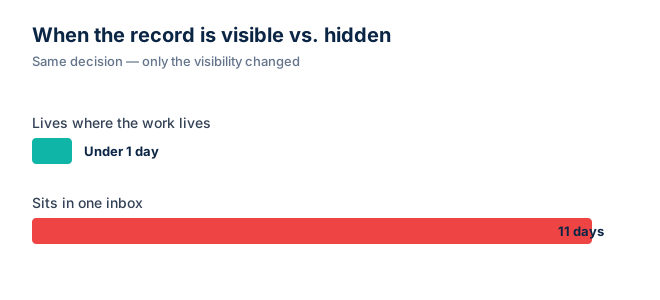
Where the proof goes to hide
Here is what belongs in one place, with a name and a date on every item:
Closeout and retention. What was delivered, who signed for it, and proof you kept what you must keep.
The decision record. Who approved what, when, and on what basis — captured as it happened, not reconstructed under pressure.
Meeting minutes and direction. Especially anything that changed scope, schedule, or budget.
Procurement justification. Why this vendor, this price, this process — documented at the time, not rationalized after.
The contract and its change orders. The original plus every amendment, in order, with nothing living only in an email thread.
You don't solve this with another reminder or another folder. You solve it by making the record a by-product of doing the work, not a second job.
This is the problem one auditable system was designed around: one source of truth for tenure, stewardship records, and field compliance, ingesting from the inboxes and folders you already use, so nothing has to be reassembled later.
Teams stand it up fast: one auditable system deploys in days, not the months a traditional system takes, and it carries unlimited users, so every partner, reviewer, and field lead works from the same picture.
Being delivery-ready early — with the record built in from day one — is the quiet advantage. It doesn't make headlines, but it's the difference between a project that finishes and one that stalls.
What a 90-day fix actually looks like
Week 1 — pick one project. Choose a live file with real stakes, not a pilot in a corner. Real stakes force real decisions.
Weeks 2–3 — consolidate the record. Pull contracts, drawings, change orders and approvals into one place and label the live versions.
Weeks 4–8 — wire in approvals. Move sign-offs out of email and into the record. Every approval leaves a timestamp and a name.
Weeks 9–12 — rehearse the audit. Pretend a funder is at the door and run a dry export. If it is clean, repeat the pattern on the next project.
Ninety days is enough to prove the pattern on one file. It is not enough to boil the ocean, and that is the point. Capital teams do not need a transformation programme — they need one project that is visibly easier to run, so the next one can copy it.
Want to see what one source of truth looks like for your projects? Talk to us — it's a short conversation.