One Source of Truth: The Case for Non-profits in 2025

When tariff uncertainty reshaping procurement dominated the headlines in 2025, non-profits felt the pressure shift. The era of arguing for funding is giving way to a harder era of accounting for it.
The stakes are simple. When you can't show a decision, you don't just lose an argument — you lose time, money, and the benefit of the doubt, usually all at once.
Where the proof goes to hide
Where the wheels usually come off
In practice, the trouble rarely starts with the headline number. It starts in the gaps between systems. A scope change gets emailed to one person, a revised drawing lands in a shared folder nobody monitors, and an invoice arrives referencing a contract version that two teams remember differently. Each gap is small. Stacked together, they explain most of the delay, rework and finger-pointing on a typical capital file.
The other quiet failure mode is staff turnover. When the person who 'just knew' how a file was structured leaves, the institutional memory leaves with them. New hires spend their first months reconstructing context that should already be on the record. Meanwhile, the project keeps moving and decisions still need to be made — often without the full picture.
A good test is to ask any team member: if you were hit by a bus tomorrow, could someone else pick up this file by 9 a.m. And know what's been decided, what's outstanding, and what's been paid? On most files, the honest answer is no. That is the gap XNM-VISION is built to close.
Decisions are scattered. Approvals live in inboxes, meeting minutes and side conversations instead of on the record.
Documents drift out of date. There is rarely one canonical version, so teams quote different numbers in good faith.
Audit prep is a scramble. Year-end review becomes a week of forensic searching instead of one tidy export.
The pattern is familiar to non-profits: each system holds a piece of the truth, no system holds all of it, and the gaps between them are exactly where projects quietly bleed.
For non-profits juggling grant-funded work and reporting deadlines, the gap is structural, not personal. No amount of diligence closes a gap that is built into how the tools are wired together.
Step back and the pattern is almost mechanical. Money arrives, ambition rises, the project grows — and the volume of decisions grows with it, faster than any inbox or folder can keep straight. For non-profits, the failure is rarely dramatic; it is a slow accumulation of small, unrecorded moments that only add up to a problem when someone with authority starts asking questions. Tariff uncertainty reshaping procurement is making that someone show up sooner, and more often. The teams that feel calm about it are not working harder — they simply never let the record and the work drift apart in the first place.
When a project gets questioned, these are the items everyone scrambles for:
An approval sitting in one person's inbox, with no backup and no clock anyone else can see
A contract on a personal drive that the field crew never opens
A change order buried in an email thread
A verbal 'go ahead' that left no trace
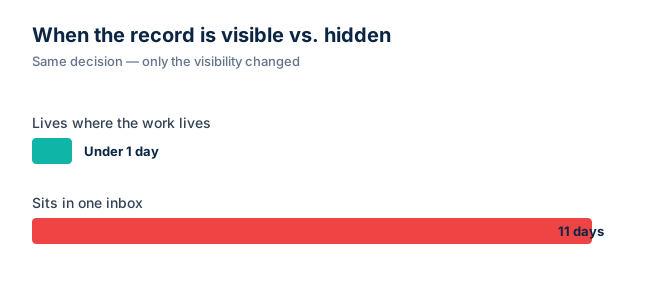
Make ready your resting state
Put plainly, an audit-ready project keeps these together from day one:
Meeting minutes and direction. Especially anything that changed scope, schedule, or budget.
The contract and its change orders. The original plus every amendment, in order, with nothing living only in an email thread.
The decision record. Who approved what, when, and on what basis — captured as it happened, not reconstructed under pressure.
Procurement justification. Why this vendor, this price, this process — documented at the time, not rationalized after.
Version history. Proof of which drawing, spec, or policy was current on any given day.
None of this is a discipline problem. Diligent people lose records every day. It's a structure problem — and structure is fixable.
XNM-VISION turns the scattered exhaust of a project into a single auditable record. For non-profits, that means a partner, funder, or auditor can be answered in minutes, not weeks.
And it scales with the work, not the headcount: from a single capital projects to a whole portfolio, the record stays consistent, current, and provable on demand.
Being delivery-ready early — with the record built in from day one — is the quiet advantage. It doesn't make headlines, but it's the difference between a project that finishes and one that stalls.
What a 90-day fix actually looks like
Week 1 — pick one project. Choose a live file with real stakes, not a pilot in a corner. Real stakes force real decisions.
Weeks 2–3 — consolidate the record. Pull contracts, drawings, change orders and approvals into one place and label the live versions.
Weeks 4–8 — wire in approvals. Move sign-offs out of email and into the record. Every approval leaves a timestamp and a name.
Weeks 9–12 — rehearse the audit. Pretend a funder is at the door and run a dry export. If it is clean, repeat the pattern on the next project.
Ninety days is enough to prove the pattern on one file. It is not enough to boil the ocean, and that is the point. Capital teams do not need a transformation programme — they need one project that is visibly easier to run, so the next one can copy it.
This is the gap XNM closes for capital teams. Learn how in our overview of XNM-VISION.