The Records Test: Could Health authorities Prove It Tomorrow?

Ask anyone running facility projects under strict compliance what kept them up in 2024, and the federal housing-supply push is only half the answer. The other half is quieter: the fear of not being able to find the one record that settles a question.
The quiet truth is that most overruns aren't decisions gone wrong. They're decisions that went fine but couldn't be proven, defended, or found in time.
Funded is not the same as finished
The pattern is familiar to health authorities: each system holds a piece of the truth, no system holds all of it, and the gaps between them are exactly where projects quietly bleed.
The cost isn't only the missing document. It's the meeting to look for it, the second meeting to recreate it, and the slow erosion of trust every time someone has to say 'let me get back to you on that.'
There is a reason this keeps happening even to careful health authorities. The tools that hold the work — email, shared drives, spreadsheets, a project app or two — were each built to do one job well, not to keep a single, time-stamped record of what was decided and why. So the record becomes a manual chore bolted onto the real work, and it is the first thing to slip when facility projects under strict compliance gets busy. In a year shaped by the federal housing-supply push, that one dropped chore is exactly what returns, months later, as a finding, a dispute, or a number nobody can explain.
What a "clean record" actually looks like
Teams often agree they want a 'clean record' without agreeing on what that means. In practice it is narrower than people think. A clean record can answer four questions in under a minute: what was decided, who decided it, when it became effective, and what version of the document the decision pointed to. If any of those four require a phone call, the record is not yet clean.
Most of the work to get there is not technical. It is naming and placement. A document that lives in three folders with three slightly different names cannot serve as proof. A document that lives in one place, with one canonical name, one owner, and a date, can survive any review.
A single canonical location, not a copy in every inbox
A name that reads the same to a clerk, an auditor, and a partner
A status that is current, superseded, or draft — never ambiguous
A small change log that explains why this version replaced the last
The cost of "we will sort it later"
The phrase 'we will sort it later' usually means the work will be done twice: once now under deadline, and once again when someone asks for proof. The second pass is the expensive one because the people who made the original decision have moved on, the context is gone, and the burden of reconstruction falls on whoever happens to be in the room.
A record that is built as the work happens — not after — turns that second pass into a lookup. The question stops being 'can we find it?' and becomes 'who needs to see it?' That is the shift that pays for itself within a single review cycle.
How XNM-VISION helps
In practice, the gaps cluster in a few familiar places:
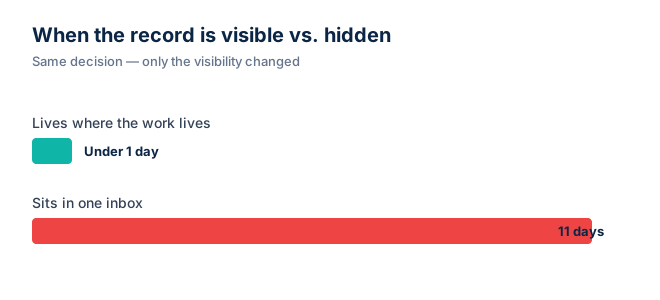
An approval sitting in one person's inbox, with no backup and no clock anyone else can see
A contract on a personal drive that the field crew never opens
A change order buried in an email thread
A verbal 'go ahead' that left no trace
The records that settle questions
The short list of what should never be left scattered:
The contract and its change orders. The original plus every amendment, in order, with nothing living only in an email thread.
Approvals and sign-offs. Every gate with a name and date attached, visible to everyone the decision touches.
Meeting minutes and direction. Especially anything that changed scope, schedule, or budget.
Version history. Proof of which drawing, spec, or policy was current on any given day.
Procurement justification. Why this vendor, this price, this process — documented at the time, not rationalized after.
The way out is not more effort. It's a single place where the decision, the document, and the work are the same object.
With one auditable system, health authorities stop hunting. The approval, the current version, and the justification sit together with a full trail — visible to everyone the decision touches, on a clock anyone can see.
Crucially, one auditable system doesn't ask health authorities to change how they work. It sits on top of the sources you already have, turning scattered effort into one auditable trail without a migration project.
The lesson repeats across every sector. You don't survive scrutiny by preparing for it. You survive by never being in a position that needs preparing.
XNM-VISION sits underneath the work as the records layer. Documents, decisions, approvals, and version history live in one place, with role-based access so the right people see the right things. Audit trails are produced as a by-product of normal work, not assembled at the end of the quarter. When a funder, board member, or partner asks a question, the answer is one search away — and it points at a specific document, not a folder.
The platform deploys quickly, fits the tools teams already use, and scales from a single capital project to a portfolio without changing how people work day-to-day. That is the practical promise: less time on the search, more time on the work.
This is the gap XNM closes for capital teams. Learn how in our overview of XNM-VISION.