Funded, Approved, and Still Stuck: Forestry operators in 2024

Ask anyone running tenure, stewardship records, and field compliance what kept them up in 2024, and Budget 2024's Indigenous Loan Guarantee Program is only half the answer. The other half is quieter: the fear of not being able to find the one record that settles a question.
The stakes are simple. When you can't show a decision, you don't just lose an argument — you lose time, money, and the benefit of the doubt, usually all at once.
Funded is not the same as finished
Most forestry operators are managing tenure, stewardship records, and field compliance across email, spreadsheets, and three or four tools that don't talk to each other. The information exists. It just can't be assembled when it counts.
And it bites hardest exactly when it matters most. The day a funder calls, the week an audit lands, the moment a dispute starts — that is when forestry operators learn which records they can actually produce and which they only thought they had.
Picture the opposite, just for a moment. A capital projects where every approval, version, and dollar lands in one place as it happens, each stamped with a name and a date, visible to everyone the work touches. When a funder calls or an auditor schedules a review, nothing has to be reconstructed — the answer is already there, assembled by the act of doing the work. For forestry operators, that is not a fantasy or a bigger budget; it is a different default. And in an era defined by Budget 2024's Indigenous Loan Guarantee Program, that default is quietly becoming the line between the teams that deliver and the teams that stall.
Where most programs lose time
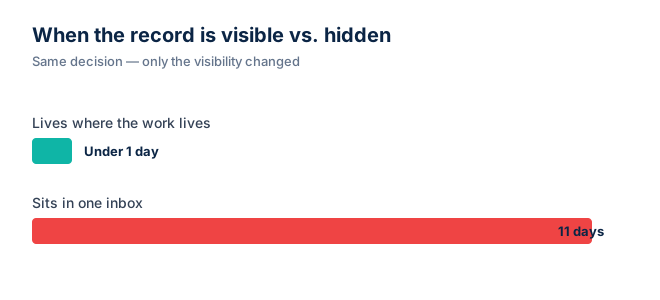
There is a predictable place where programs leak hours: the handoff between people who made a decision and the people who must execute or report on it. The decision sits in someone's head, or in a thread, or in a meeting note that was never circulated. The executor reconstructs from fragments. The reporter calls both of them.
When the underlying record is named, dated, owned, and visible, the handoff stops costing hours. The executor reads the record. The reporter reads the record. The original decider keeps working. No one is interrupted to explain something that was already written down.
Capture at the source. The person who made the decision writes the one-line summary, not the person who heard about it third-hand.
Link to the document. The decision points at the exact version it was based on, not a folder.
Name an owner. One person is accountable for keeping the record current as facts change.
Set a review date. Records that are never re-checked drift; a small recurring review keeps them honest.
How XNM-VISION changes the day-to-day
The practical change inside a team using XNM-VISION is small but cumulative. Decisions are written where the documents already live. Versions are not a question of memory. Permissions are tied to role, so the right people see the right things without anyone having to remember to share. Over a quarter, the meetings that existed only to reconstruct context simply stop being scheduled.
That is the quiet outcome of records-as-infrastructure: the team gets time back, and the reviewer gets answers instead of a tour of the file system.
A short, practical checklist
When a project gets questioned, these are the items everyone scrambles for:
Which version of the budget is the real one
Whether a scope change was ever formally approved
The minutes where direction actually changed
Closeout proof of what was delivered and who signed for it
Funded is not the same as finished
Put plainly, an audit-ready project keeps these together from day one:
Approvals and sign-offs. Every gate with a name and date attached, visible to everyone the decision touches.
Closeout and retention. What was delivered, who signed for it, and proof you kept what you must keep.
The decision record. Who approved what, when, and on what basis — captured as it happened, not reconstructed under pressure.
Version history. Proof of which drawing, spec, or policy was current on any given day.
The contract and its change orders. The original plus every amendment, in order, with nothing living only in an email thread.
The fix isn't 'try harder.' It's to stop keeping the record separate from the work, so the proof accumulates on its own.
XNM-VISION closes that gap for forestry operators. Every decision, document, and dollar lives in one place, captured as the work happens, so 'audit-ready' is your resting state rather than a sprint.
What changes the result for forestry operators is not another database. It's that XNM-VISION captures the record as a by-product of the work, ingesting from the inboxes and folders you already use — so being ready costs no extra effort.
Being delivery-ready early — with the record built in from day one — is the quiet advantage. It doesn't make headlines, but it's the difference between a project that finishes and one that stalls.
Before any new initiative starts, run a five-minute test on the records that will support it. Can you point to the canonical version of the scope, the budget, the schedule, and the approvals — each in one place, each with a date and an owner? If any of the four is missing, fix that before the work begins; you will not have a calmer time to fix it later.
This is not paperwork for its own sake. It is the foundation that lets the work actually move. A team that can answer the four questions in under a minute is a team that gets to spend its time on the project, not on the search for the project.
If your last review felt like a fire drill, that's a records problem, not a character flaw — and a solvable one. See how teams make ready their resting state with XNM-VISION.