Straight Answers for Non-profits on the Audit Question

Budget 2024's Indigenous Loan Guarantee Program made one thing clear in 2024: getting capital projects approved is no longer the bottleneck. Delivering them — and being able to show your work — is.
The quiet truth is that most overruns aren't decisions gone wrong. They're decisions that went fine but couldn't be proven, defended, or found in time.
Funded is not the same as finished
The pattern is familiar to non-profits: each system holds a piece of the truth, no system holds all of it, and the gaps between them are exactly where projects quietly bleed.
Look closer at any non-profits and the same fault line appears: the people doing the work and the people who must answer for it are reading from different copies. One has the latest drawing; the other has last month's.
There is a reason this keeps happening even to careful non-profits. The tools that hold the work — email, shared drives, spreadsheets, a project app or two — were each built to do one job well, not to keep a single, time-stamped record of what was decided and why. So the record becomes a manual chore bolted onto the real work, and it is the first thing to slip when grant-funded work and reporting deadlines gets busy. In a year shaped by Budget 2024's Indigenous Loan Guarantee Program, that one dropped chore is exactly what returns, months later, as a finding, a dispute, or a number nobody can explain.
What a "clean record" actually looks like
Teams often agree they want a 'clean record' without agreeing on what that means. In practice it is narrower than people think. A clean record can answer four questions in under a minute: what was decided, who decided it, when it became effective, and what version of the document the decision pointed to. If any of those four require a phone call, the record is not yet clean.
Most of the work to get there is not technical. It is naming and placement. A document that lives in three folders with three slightly different names cannot serve as proof. A document that lives in one place, with one canonical name, one owner, and a date, can survive any review.
A single canonical location, not a copy in every inbox
A name that reads the same to a clerk, an auditor, and a partner
A status that is current, superseded, or draft — never ambiguous
A small change log that explains why this version replaced the last
The cost of "we will sort it later"
The phrase 'we will sort it later' usually means the work will be done twice: once now under deadline, and once again when someone asks for proof. The second pass is the expensive one because the people who made the original decision have moved on, the context is gone, and the burden of reconstruction falls on whoever happens to be in the room.
A record that is built as the work happens — not after — turns that second pass into a lookup. The question stops being 'can we find it?' and becomes 'who needs to see it?' That is the shift that pays for itself within a single review cycle.
How XNM-VISION helps
When a project gets questioned, these are the items everyone scrambles for:
An approval sitting in one person's inbox, with no backup and no clock anyone else can see
A contract on a personal drive that the field crew never opens
A change order buried in an email thread
A verbal 'go ahead' that left no trace
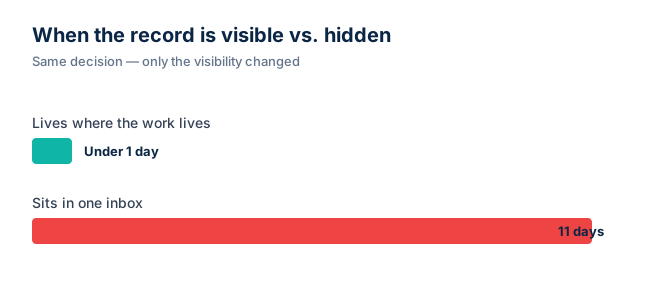
What Budget 2024's Indigenous Loan Guarantee Program actually changes
Here is what belongs in one place, with a name and a date on every item:
Meeting minutes and direction. Especially anything that changed scope, schedule, or budget.
Version history. Proof of which drawing, spec, or policy was current on any given day.
Procurement justification. Why this vendor, this price, this process — documented at the time, not rationalized after.
Approvals and sign-offs. Every gate with a name and date attached, visible to everyone the decision touches.
Closeout and retention. What was delivered, who signed for it, and proof you kept what you must keep.
The fix isn't 'try harder.' It's to stop keeping the record separate from the work, so the proof accumulates on its own.
This is the problem one auditable system was designed around: one source of truth for grant-funded work and reporting deadlines, ingesting from the inboxes and folders you already use, so nothing has to be reassembled later.
Teams stand it up fast: one auditable system deploys in days, not the months a traditional system takes, and it carries unlimited users, so every partner, reviewer, and field lead works from the same picture.
Being delivery-ready early — with the record built in from day one — is the quiet advantage. It doesn't make headlines, but it's the difference between a project that finishes and one that stalls.
XNM-VISION sits underneath the work as the records layer. Documents, decisions, approvals, and version history live in one place, with role-based access so the right people see the right things. Audit trails are produced as a by-product of normal work, not assembled at the end of the quarter. When a funder, board member, or partner asks a question, the answer is one search away — and it points at a specific document, not a folder.
The platform deploys quickly, fits the tools teams already use, and scales from a single capital project to a portfolio without changing how people work day-to-day. That is the practical promise: less time on the search, more time on the work.
XNM has helped public-sector and capital teams make audit-ready their normal state since 2013. See how XNM-VISION works.