Straight Answers for Northern infrastructure teams on the Audit Question

Through 2024, northern infrastructure teams watched the 2024 fall fiscal update move money and attention toward big builds. The capital is the easy part. The hard part shows up later, in whether you can prove what you decided and when.
And the bill always comes due at the worst moment: mid-build, mid-audit, or mid-dispute, when the missing piece is suddenly the only piece that matters.
What the 2024 fall fiscal update actually changes
The pattern is familiar to northern infrastructure teams: each system holds a piece of the truth, no system holds all of it, and the gaps between them are exactly where projects quietly bleed.
It compounds over time. Every handoff between northern infrastructure teams and their partners is a chance for a version to fork, an approval to go unrecorded, or a commitment to survive only in someone's memory.
Step back and the pattern is almost mechanical. Money arrives, ambition rises, the project grows — and the volume of decisions grows with it, faster than any inbox or folder can keep straight. For northern infrastructure teams, the failure is rarely dramatic; it is a slow accumulation of small, unrecorded moments that only add up to a problem when someone with authority starts asking questions. The 2024 fall fiscal update is making that someone show up sooner, and more often. The teams that feel calm about it are not working harder — they simply never let the record and the work drift apart in the first place.
The usual suspects, every time:
Which version of the budget is the real one
Whether a scope change was ever formally approved
The minutes where direction actually changed
Closeout proof of what was delivered and who signed for it
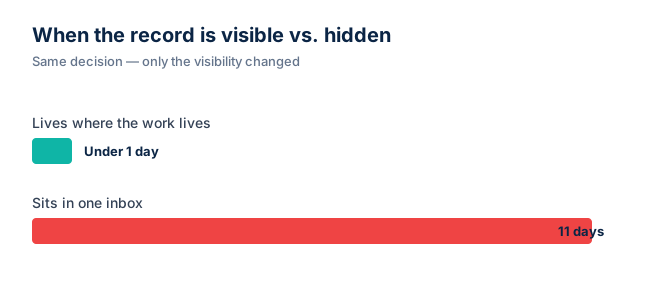
The decision wasn't wrong — it was invisible
Put plainly, an audit-ready project keeps these together from day one:
The decision record. Who approved what, when, and on what basis — captured as it happened, not reconstructed under pressure.
The contract and its change orders. The original plus every amendment, in order, with nothing living only in an email thread.
Procurement justification. Why this vendor, this price, this process — documented at the time, not rationalized after.
Approvals and sign-offs. Every gate with a name and date attached, visible to everyone the decision touches.
Invoices matched to the contract. Each dollar paid, tied to the commitment that authorized it.
What changes the outcome isn't heroics at audit time. It's removing the gap between doing the work and recording it.
XNM-VISION closes that gap for northern infrastructure teams. Every decision, document, and dollar lives in one place, captured as the work happens, so 'audit-ready' is your resting state rather than a sprint.
Crucially, XNM-VISION doesn't ask northern infrastructure teams to change how they work. It sits on top of the sources you already have, turning scattered effort into one auditable trail without a migration project.
Funding gets you to the starting line. Records are what carry you across it. In a year defined by the 2024 fall fiscal update, that distinction is the whole game.
What this looks like in practice
Picture a mid-sized capital build at month nine. A scope question lands in a Friday email: did the owner ever approve the change to the mechanical run on level three, and at what number? In the old world, that question burns half a day. Someone digs through inboxes, pulls a PDF from a shared drive, and emails three people for memory. In a one-source-of-truth world, the answer is one search. The approval appears with its date, its author, the version of the drawing it referenced, and the dollar figure it locked in. The thread closes in two minutes, and the cost engineer keeps moving.
That small difference – hours saved on a single question – stops being small when you multiply it across a year of decisions. Capital projects run on hundreds of these little moments. Each one is a chance for the record to slip and the story to drift. Closing that gap is less glamorous than a new dashboard or a fresh report, but it is where the real money is.
The three habits that compound
Capture the decision where it happens, not in a separate log written from memory at the end of the week.
Tag the document to the project, the phase, and the dollar line it touches – once – so future searches are trivial.
Treat every external reply as part of the file, not as a private inbox artifact only one person can find later.
Teams that adopt these three habits stop having quarterly fire drills before audits and stop losing sleep before board meetings. The record is just there, ready, and the conversation moves on to what the project actually needs next.
A practical first month
Most teams do not need a six-month rollout to feel the difference. A pragmatic first month focuses on a few high-leverage moves and lets the rest settle in naturally as people use the system.
Week one – pick one live project. Start with a project that has real decisions flowing this month, not a finished one. The point is to capture work as it happens, not to retro-fit history.
Week two – wire in the existing sources. Connect the document drives, email folders, and finance exports already in use. Nothing changes about where work happens – only where the record settles.
Week three – set the tagging defaults. Decide once how items are tagged to projects and phases, then let the system apply those defaults so people do not have to think about it on every save.
Week four – run a real query. Pick a question the team has actually struggled with this year – a scope, a payment, a sign-off – and watch how fast it answers now. That moment is when the team buys in.
By the end of that month, the change is not theoretical. People feel it. The Friday email gets answered in two minutes. The board pack is half-built before anyone sits down to write it. The auditor's first three requests come back the same day.
Why this matters now
Capital programs in 2024 are bigger, scrutinized harder, and run by leaner teams than they were five years ago. The expectation that a serious organization can answer a serious question quickly is no longer optional. Funders ask. Partners ask. Boards ask. The teams that win the next round of work are not the ones with the loudest pitch – they are the ones who can prove what they did, on demand, without drama.
XNM-VISION is built for exactly that posture. It is not a replacement for the people doing the work; it is the place that quietly keeps their record straight so they can spend their time on judgment, not archaeology. Over a year, the cumulative effect is fewer surprises, faster approvals, and a project narrative that holds up to any reasonable question – because the underlying record is the same record everyone has been using all along.
We take apart a failure like this every week. Closing exactly this gap is why we built XNM-VISION.