After tighter scrutiny of provincial capital plans: The Question Developers Should Be Asking

Tighter scrutiny of provincial capital plans made one thing clear in 2024: getting capital projects approved is no longer the bottleneck. Delivering them — and being able to show your work — is.
The stakes are simple. When you can't show a decision, you don't just lose an argument — you lose time, money, and the benefit of the doubt, usually all at once.
What tighter scrutiny of provincial capital plans actually changes
The real problem for developers isn't missing information — it's unfindable information. The approval, the version, the justification all exist; they just don't live where the work can see them.
And it bites hardest exactly when it matters most. The day a funder calls, the week an audit lands, the moment a dispute starts — that is when developers learn which records they can actually produce and which they only thought they had.
It helps to name the real adversary, because it is not incompetence. For developers, the adversary is entropy — the natural tendency of a busy project to scatter its own evidence across people, tools, and time until no single place holds the whole truth. Every reorganization, every staff change, every 'we'll clean it up later' feeds it. Tighter scrutiny of provincial capital plans did not create this problem, but it raised the cost of it, because more scrutiny means more moments when scattered evidence has to be pulled back together at speed. Structure is the only thing that reliably beats entropy.
The usual suspects, every time:
A funder's reporting requirement nobody mapped to a document
An approval that exists but isn't visible to the work
A commitment made in a meeting and never written down
The one attachment that proves the whole timeline
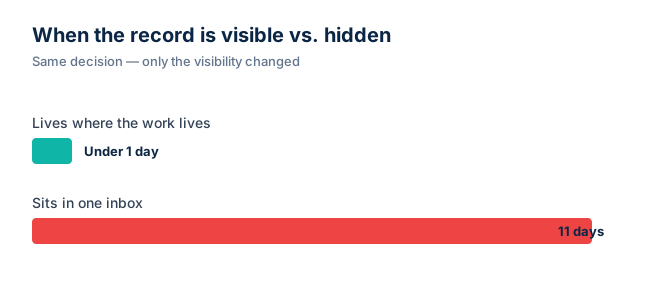
Where the proof goes to hide
Put plainly, an audit-ready project keeps these together from day one:
Procurement justification. Why this vendor, this price, this process — documented at the time, not rationalized after.
Invoices matched to the contract. Each dollar paid, tied to the commitment that authorized it.
Approvals and sign-offs. Every gate with a name and date attached, visible to everyone the decision touches.
Version history. Proof of which drawing, spec, or policy was current on any given day.
Closeout and retention. What was delivered, who signed for it, and proof you kept what you must keep.
The fix isn't 'try harder.' It's to stop keeping the record separate from the work, so the proof accumulates on its own.
With one auditable system, developers stop hunting. The approval, the current version, and the justification sit together with a full trail — visible to everyone the decision touches, on a clock anyone can see.
What changes the result for developers is not another database. It's that one auditable system captures the record as a by-product of the work, ingesting from the inboxes and folders you already use — so being ready costs no extra effort.
Tighter scrutiny of provincial capital plans raised the ceiling on what's possible. Whether developers reach it comes down to something unglamorous: whether the proof was there all along.
What this looks like in practice
Picture a mid-sized capital build at month nine. A scope question lands in a Friday email: did the owner ever approve the change to the mechanical run on level three, and at what number? In the old world, that question burns half a day. Someone digs through inboxes, pulls a PDF from a shared drive, and emails three people for memory. In a one-source-of-truth world, the answer is one search. The approval appears with its date, its author, the version of the drawing it referenced, and the dollar figure it locked in. The thread closes in two minutes, and the cost engineer keeps moving.
That small difference – hours saved on a single question – stops being small when you multiply it across a year of decisions. Capital projects run on hundreds of these little moments. Each one is a chance for the record to slip and the story to drift. Closing that gap is less glamorous than a new dashboard or a fresh report, but it is where the real money is.
The three habits that compound
Capture the decision where it happens, not in a separate log written from memory at the end of the week.
Tag the document to the project, the phase, and the dollar line it touches – once – so future searches are trivial.
Treat every external reply as part of the file, not as a private inbox artifact only one person can find later.
Teams that adopt these three habits stop having quarterly fire drills before audits and stop losing sleep before board meetings. The record is just there, ready, and the conversation moves on to what the project actually needs next.
A practical first month
Most teams do not need a six-month rollout to feel the difference. A pragmatic first month focuses on a few high-leverage moves and lets the rest settle in naturally as people use the system.
Week one – pick one live project. Start with a project that has real decisions flowing this month, not a finished one. The point is to capture work as it happens, not to retro-fit history.
Week two – wire in the existing sources. Connect the document drives, email folders, and finance exports already in use. Nothing changes about where work happens – only where the record settles.
Week three – set the tagging defaults. Decide once how items are tagged to projects and phases, then let the system apply those defaults so people do not have to think about it on every save.
Week four – run a real query. Pick a question the team has actually struggled with this year – a scope, a payment, a sign-off – and watch how fast it answers now. That moment is when the team buys in.
By the end of that month, the change is not theoretical. People feel it. The Friday email gets answered in two minutes. The board pack is half-built before anyone sits down to write it. The auditor's first three requests come back the same day.
Why this matters now
Capital programs in 2024 are bigger, scrutinized harder, and run by leaner teams than they were five years ago. The expectation that a serious organization can answer a serious question quickly is no longer optional. Funders ask. Partners ask. Boards ask. The teams that win the next round of work are not the ones with the loudest pitch – they are the ones who can prove what they did, on demand, without drama.
XNM-VISION is built for exactly that posture. It is not a replacement for the people doing the work; it is the place that quietly keeps their record straight so they can spend their time on judgment, not archaeology. Over a year, the cumulative effect is fewer surprises, faster approvals, and a project narrative that holds up to any reasonable question – because the underlying record is the same record everyone has been using all along.
Want to see what one source of truth looks like for your projects? Talk to us — it's a short conversation.