Straight Answers for Developers on the Audit Question

Every developer we talk to has the same 2025 story. Tariff uncertainty reshaping procurement raised the stakes, the project got bigger, and the paperwork that proves it got harder to keep straight.
And the bill always comes due at the worst moment: mid-build, mid-audit, or mid-dispute, when the missing piece is suddenly the only piece that matters.
Funded is not the same as finished
developers rarely fail for lack of effort. They fail because the proof is scattered — a sign-off here, an invoice there, a change order in a thread no one can find under pressure.
It compounds over time. Every handoff between developers and their partners is a chance for a version to fork, an approval to go unrecorded, or a commitment to survive only in someone's memory.
There is a reason this keeps happening even to careful developers. The tools that hold the work — email, shared drives, spreadsheets, a project app or two — were each built to do one job well, not to keep a single, time-stamped record of what was decided and why. So the record becomes a manual chore bolted onto the real work, and it is the first thing to slip when pro formas, draws, and a wall of contracts gets busy. In a year shaped by tariff uncertainty reshaping procurement, that one dropped chore is exactly what returns, months later, as a finding, a dispute, or a number nobody can explain.
Here is where the proof tends to hide:
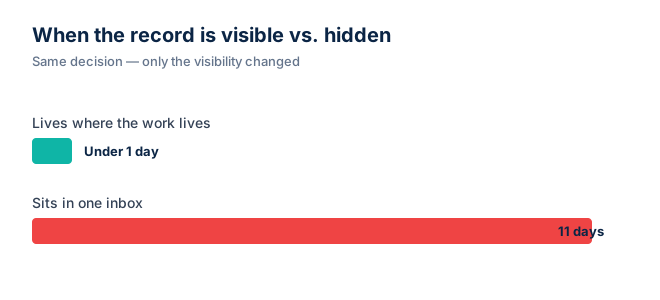
An approval sitting in one person's inbox, with no backup and no clock anyone else can see
A contract on a personal drive that the field crew never opens
A change order buried in an email thread
A verbal 'go ahead' that left no trace
Make ready your resting state
What auditors actually look for
The most common cause of an audit finding is not misconduct. It is missing context. An invoice that was paid for the right reason but cannot be tied to the approval that authorized it. A change order that was warranted but cannot be tied to the field condition that justified it. A closeout that was completed but cannot be tied to the deliverables list in the original contract. In each case, the work was done correctly. The record could not prove it.
The fix is not more documentation. Most teams already produce too much. The fix is structure: every record that matters tied to the project, the contract, the budget line, and the person who authorized it, in a system the auditor can read without a tour.
A practical checklist for the next audit cycle
Single project record. Every project has one canonical entry with its scope, budget, funding source, and current status. Side spreadsheets are reconciled to it, not the other way around.
Linked contracts and amendments. Every executed contract is attached to the project record with its current value, change-order history, and retainage position.
Invoice trail. Every invoice points to a contract, a line item, and an approver. No invoice exists in isolation.
Closeout package. Every completed scope has a closeout folder with the original contract, all amendments, the final accounting, and the deliverables that prove completion.
None of this is unusual. It is the standard the best teams already hold themselves to. What changes with a records engine is that the standard becomes the default, not an after-hours exercise.
Put plainly, an audit-ready project keeps these together from day one:
Invoices matched to the contract. Each dollar paid, tied to the commitment that authorized it.
Meeting minutes and direction. Especially anything that changed scope, schedule, or budget.
The contract and its change orders. The original plus every amendment, in order, with nothing living only in an email thread.
The decision record. Who approved what, when, and on what basis — captured as it happened, not reconstructed under pressure.
Closeout and retention. What was delivered, who signed for it, and proof you kept what you must keep.
You don't solve this with another reminder or another folder. You solve it by making the record a by-product of doing the work, not a second job.
one auditable system turns the scattered exhaust of a project into a single auditable record. For developers, that means a partner, funder, or auditor can be answered in minutes, not weeks.
And it scales with the work, not the headcount: from a single capital projects to a whole portfolio, the record stays consistent, current, and provable on demand.
Funding gets you to the starting line. Records are what carry you across it. In a year defined by tariff uncertainty reshaping procurement, that distinction is the whole game.
How XNM-VISION turns this into a daily habit
The reason these problems persist on capable teams is structural, not personal. The records, approvals, and decisions that prove a project live in different systems with different owners. XNM-VISION holds them together in one tenant-scoped workspace: every project has a record, every record has its documents and links, every change is audit-logged with the user and time. The work of staying ready stops being a separate workstream and becomes a side effect of doing the work itself.
That shift — from periodic catch-up to continuous readiness — is what changes outcomes. The funder report writes itself from the records already in the system. The audit walk-through is a tour of what is already there, not a scramble to assemble it. The leadership update is a current view, not a recreation. And when a market or policy change arrives, the response time shrinks from weeks to hours, because the data needed to decide is already in one place.
This is the gap XNM closes for capital teams. Learn how in our overview of XNM-VISION.