Straight Answers for Project teams on the Audit Question

Through 2025, project teams watched tariff uncertainty reshaping procurement move money and attention toward big builds. The capital is the easy part. The hard part shows up later, in whether you can prove what you decided and when.
This matters because the cost of a lost record is rarely the record. It's the six weeks, the redone work, and the credibility you spend reconstructing something you already had.
Where the proof goes to hide
The pattern is familiar to project teams: each system holds a piece of the truth, no system holds all of it, and the gaps between them are exactly where projects quietly bleed.
And it bites hardest exactly when it matters most. The day a funder calls, the week an audit lands, the moment a dispute starts — that is when project teams learn which records they can actually produce and which they only thought they had.
Picture the opposite, just for a moment. A capital projects where every approval, version, and dollar lands in one place as it happens, each stamped with a name and a date, visible to everyone the work touches. When a funder calls or an auditor schedules a review, nothing has to be reconstructed — the answer is already there, assembled by the act of doing the work. For project teams, that is not a fantasy or a bigger budget; it is a different default. And in an era defined by tariff uncertainty reshaping procurement, that default is quietly becoming the line between the teams that deliver and the teams that stall.
In practice, the gaps cluster in a few familiar places:
A funder's reporting requirement nobody mapped to a document
An approval that exists but isn't visible to the work
A commitment made in a meeting and never written down
The one attachment that proves the whole timeline
Make ready your resting state
What auditors actually look for
The most common cause of an audit finding is not misconduct. It is missing context. An invoice that was paid for the right reason but cannot be tied to the approval that authorized it. A change order that was warranted but cannot be tied to the field condition that justified it. A closeout that was completed but cannot be tied to the deliverables list in the original contract. In each case, the work was done correctly. The record could not prove it.
The fix is not more documentation. Most teams already produce too much. The fix is structure: every record that matters tied to the project, the contract, the budget line, and the person who authorized it, in a system the auditor can read without a tour.
A practical checklist for the next audit cycle
Single project record. Every project has one canonical entry with its scope, budget, funding source, and current status. Side spreadsheets are reconciled to it, not the other way around.
Linked contracts and amendments. Every executed contract is attached to the project record with its current value, change-order history, and retainage position.
Invoice trail. Every invoice points to a contract, a line item, and an approver. No invoice exists in isolation.
Closeout package. Every completed scope has a closeout folder with the original contract, all amendments, the final accounting, and the deliverables that prove completion.
None of this is unusual. It is the standard the best teams already hold themselves to. What changes with a records engine is that the standard becomes the default, not an after-hours exercise.
Here is what belongs in one place, with a name and a date on every item:
Meeting minutes and direction. Especially anything that changed scope, schedule, or budget.
Approvals and sign-offs. Every gate with a name and date attached, visible to everyone the decision touches.
Invoices matched to the contract. Each dollar paid, tied to the commitment that authorized it.
Version history. Proof of which drawing, spec, or policy was current on any given day.
The decision record. Who approved what, when, and on what basis — captured as it happened, not reconstructed under pressure.
You don't solve this with another reminder or another folder. You solve it by making the record a by-product of doing the work, not a second job.
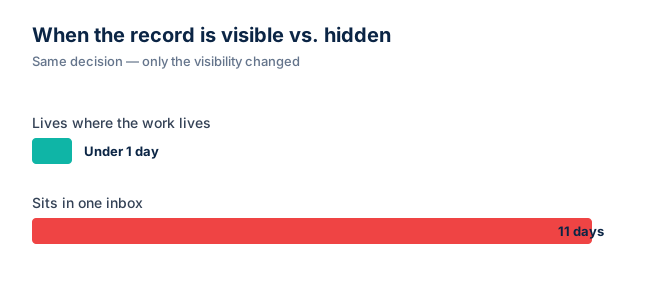
the XNM-VISION records engine closes that gap for project teams. Every decision, document, and dollar lives in one place, captured as the work happens, so 'audit-ready' is your resting state rather than a sprint.
Crucially, the XNM-VISION records engine doesn't ask project teams to change how they work. It sits on top of the sources you already have, turning scattered effort into one auditable trail without a migration project.
Funding gets you to the starting line. Records are what carry you across it. In a year defined by tariff uncertainty reshaping procurement, that distinction is the whole game.
How XNM-VISION turns this into a daily habit
The reason these problems persist on capable teams is structural, not personal. The records, approvals, and decisions that prove a project live in different systems with different owners. XNM-VISION holds them together in one tenant-scoped workspace: every project has a record, every record has its documents and links, every change is audit-logged with the user and time. The work of staying ready stops being a separate workstream and becomes a side effect of doing the work itself.
That shift — from periodic catch-up to continuous readiness — is what changes outcomes. The funder report writes itself from the records already in the system. The audit walk-through is a tour of what is already there, not a scramble to assemble it. The leadership update is a current view, not a recreation. And when a market or policy change arrives, the response time shrinks from weeks to hours, because the data needed to decide is already in one place.
If your last review felt like a fire drill, that's a records problem, not a character flaw — and a solvable one. See how teams make ready their resting state with XNM-VISION.