Funded, Approved, and Still Stuck: Audit teams in 2025

Ask anyone running working papers and the trail behind every number what kept them up in 2025, and LNG Canada's first cargo is only half the answer. The other half is quieter: the fear of not being able to find the one record that settles a question.
And the bill always comes due at the worst moment: mid-build, mid-audit, or mid-dispute, when the missing piece is suddenly the only piece that matters.
Make ready your resting state
Most audit teams are managing working papers and the trail behind every number across email, spreadsheets, and three or four tools that don't talk to each other. The information exists. It just can't be assembled when it counts.
And it bites hardest exactly when it matters most. The day a funder calls, the week an audit lands, the moment a dispute starts — that is when audit teams learn which records they can actually produce and which they only thought they had.
Step back and the pattern is almost mechanical. Money arrives, ambition rises, the project grows — and the volume of decisions grows with it, faster than any inbox or folder can keep straight. For audit teams, the failure is rarely dramatic; it is a slow accumulation of small, unrecorded moments that only add up to a problem when someone with authority starts asking questions. LNG Canada's first cargo is making that someone show up sooner, and more often. The teams that feel calm about it are not working harder — they simply never let the record and the work drift apart in the first place.
When a project gets questioned, these are the items everyone scrambles for:
The decision record — who approved what, when, and on what basis
Invoices matched to the contract that authorized them
The procurement justification, documented at the time
Version history proving which drawing was current on a given day
The records that settle questions
Here is what belongs in one place, with a name and a date on every item:
The contract and its change orders. The original plus every amendment, in order, with nothing living only in an email thread.
Meeting minutes and direction. Especially anything that changed scope, schedule, or budget.
Approvals and sign-offs. Every gate with a name and date attached, visible to everyone the decision touches.
Procurement justification. Why this vendor, this price, this process — documented at the time, not rationalized after.
Version history. Proof of which drawing, spec, or policy was current on any given day.
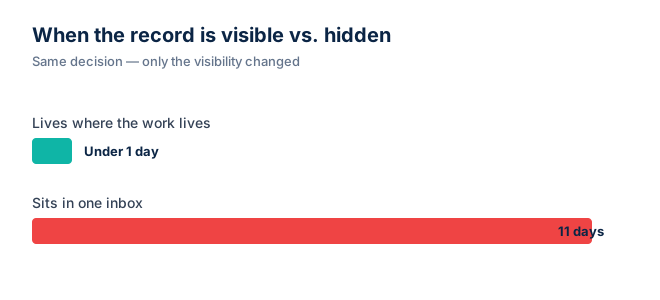
What changes the outcome isn't heroics at audit time. It's removing the gap between doing the work and recording it.
This is the problem one auditable system was designed around: one source of truth for working papers and the trail behind every number, ingesting from the inboxes and folders you already use, so nothing has to be reassembled later.
The payoff for audit teams is calm. When a question comes, the answer is already assembled — approval, version, and justification side by side — so a review becomes a search, not a scramble.
Being delivery-ready early — with the record built in from day one — is the quiet advantage. It doesn't make headlines, but it's the difference between a project that finishes and one that stalls.
What this actually looks like on a Monday morning
Picture a project lead opening the week with three questions on the table: where did last week's variance come from, did the change order get countersigned, and what does the funder need by Thursday. In a healthy system, each answer is one click away. In a fragmented one, each answer is a half-day of forwarded emails and phone calls. The difference is not effort. It is whether the record was captured at the moment the work happened, or stitched together afterwards from memory.
The teams that handle this calmly tend to share a few quiet habits. They treat the project's documents the way an accountant treats the ledger: every entry has a date, an author, and a place it belongs. They resist the temptation to keep "working copies" on personal drives. And they retire the version control conversation almost entirely, because there is only ever one current version and the older ones are visible but clearly marked.
The hidden cost of a brittle paper trail
Every hour spent reconstructing what happened is an hour not spent moving the project forward. Multiply that across a portfolio and the drag becomes structural. Worse, when the reconstruction is too costly, teams quietly stop doing it — and a small reporting gap turns into a slow erosion of trust with funders, councils, and partners. None of this shows up as a line item, but it shows up in the timeline.
Name the system of record. Pick one place where the truth lives, and make it the only place people are asked to look first.
Capture decisions where they happen. A decision made in a meeting belongs in the record before the meeting ends, not three days later in someone's notebook.
Make retrieval boring. If finding a document requires expertise, the document is effectively missing. Search, tag, and filter until the boring answer is the easy one.
A short, practical test
Pick any project that closed in the last twelve months. Ask one question: if a funder requested the full file tomorrow morning, how many people would you need to involve to produce it before noon? If the answer is more than two, the record is doing too much work in too many heads.
This is where XNM-VISION earns its keep. It is not a replacement for judgment or for the people who run the work. It is the discipline that keeps the record and the work moving together, so that the question "can you prove it?" stops being a fire drill and becomes a non-event.
This is the gap XNM closes for capital teams. Learn how in our overview of XNM-VISION.