After LNG Canada's first cargo: The Question Provincial agencies Should Be Asking

When LNG Canada's first cargo dominated the headlines in 2025, provincial agencies felt the pressure shift. The era of arguing for funding is giving way to a harder era of accounting for it.
What's really at risk isn't tidiness. It's whether a funder, an auditor, or a partner can look at your project and trust that it was run the way you say it was.
Make ready your resting state
Most provincial agencies are managing multi-year capital plans across many sites across email, spreadsheets, and three or four tools that don't talk to each other. The information exists. It just can't be assembled when it counts.
It compounds over time. Every handoff between provincial agencies and their partners is a chance for a version to fork, an approval to go unrecorded, or a commitment to survive only in someone's memory.
Consider how this plays out for provincial agencies in practice. A decision gets made in a meeting, refined over a few emails, approved with a nod, and then executed by a crew who never saw any of it written down. Months later — often once LNG Canada's first cargo has put every project under a brighter light — someone asks a question that should be easy: show me where this was approved, and by whom. The work itself was sound. The trail behind it was not. And it is precisely in that gap, between a good decision and a provable one, that budgets quietly disappear and schedules slip.
In practice, the gaps cluster in a few familiar places:
The current drawing, versus three that look almost identical
The signed copy, versus the draft everyone kept editing
The retention proof that you kept what you must keep
The single thread that explains why a number changed
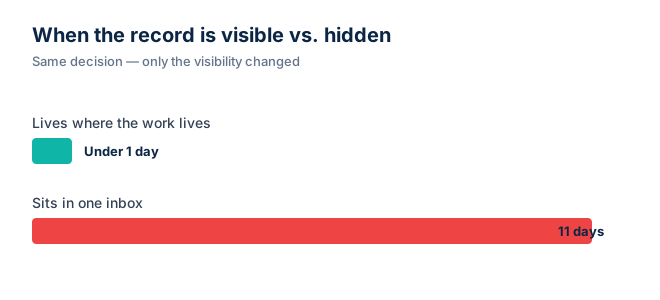
The decision wasn't wrong — it was invisible
Put plainly, an audit-ready project keeps these together from day one:
Procurement justification. Why this vendor, this price, this process — documented at the time, not rationalized after.
Closeout and retention. What was delivered, who signed for it, and proof you kept what you must keep.
Meeting minutes and direction. Especially anything that changed scope, schedule, or budget.
The decision record. Who approved what, when, and on what basis — captured as it happened, not reconstructed under pressure.
Invoices matched to the contract. Each dollar paid, tied to the commitment that authorized it.
You don't solve this with another reminder or another folder. You solve it by making the record a by-product of doing the work, not a second job.
the XNM-VISION records engine turns the scattered exhaust of a project into a single auditable record. For provincial agencies, that means a partner, funder, or auditor can be answered in minutes, not weeks.
And it scales with the work, not the headcount: from a single capital projects to a whole portfolio, the record stays consistent, current, and provable on demand.
LNG Canada's first cargo raised the ceiling on what's possible. Whether provincial agencies reach it comes down to something unglamorous: whether the proof was there all along.
What this actually looks like on a Monday morning
Picture a project lead opening the week with three questions on the table: where did last week's variance come from, did the change order get countersigned, and what does the funder need by Thursday. In a healthy system, each answer is one click away. In a fragmented one, each answer is a half-day of forwarded emails and phone calls. The difference is not effort. It is whether the record was captured at the moment the work happened, or stitched together afterwards from memory.
The teams that handle this calmly tend to share a few quiet habits. They treat the project's documents the way an accountant treats the ledger: every entry has a date, an author, and a place it belongs. They resist the temptation to keep "working copies" on personal drives. And they retire the version control conversation almost entirely, because there is only ever one current version and the older ones are visible but clearly marked.
The hidden cost of a brittle paper trail
Every hour spent reconstructing what happened is an hour not spent moving the project forward. Multiply that across a portfolio and the drag becomes structural. Worse, when the reconstruction is too costly, teams quietly stop doing it — and a small reporting gap turns into a slow erosion of trust with funders, councils, and partners. None of this shows up as a line item, but it shows up in the timeline.
Name the system of record. Pick one place where the truth lives, and make it the only place people are asked to look first.
Capture decisions where they happen. A decision made in a meeting belongs in the record before the meeting ends, not three days later in someone's notebook.
Make retrieval boring. If finding a document requires expertise, the document is effectively missing. Search, tag, and filter until the boring answer is the easy one.
A short, practical test
Pick any project that closed in the last twelve months. Ask one question: if a funder requested the full file tomorrow morning, how many people would you need to involve to produce it before noon? If the answer is more than two, the record is doing too much work in too many heads.
This is where XNM-VISION earns its keep. It is not a replacement for judgment or for the people who run the work. It is the discipline that keeps the record and the work moving together, so that the question "can you prove it?" stops being a fire drill and becomes a non-event.
XNM has helped public-sector and capital teams make audit-ready their normal state since 2013. See how XNM-VISION works.